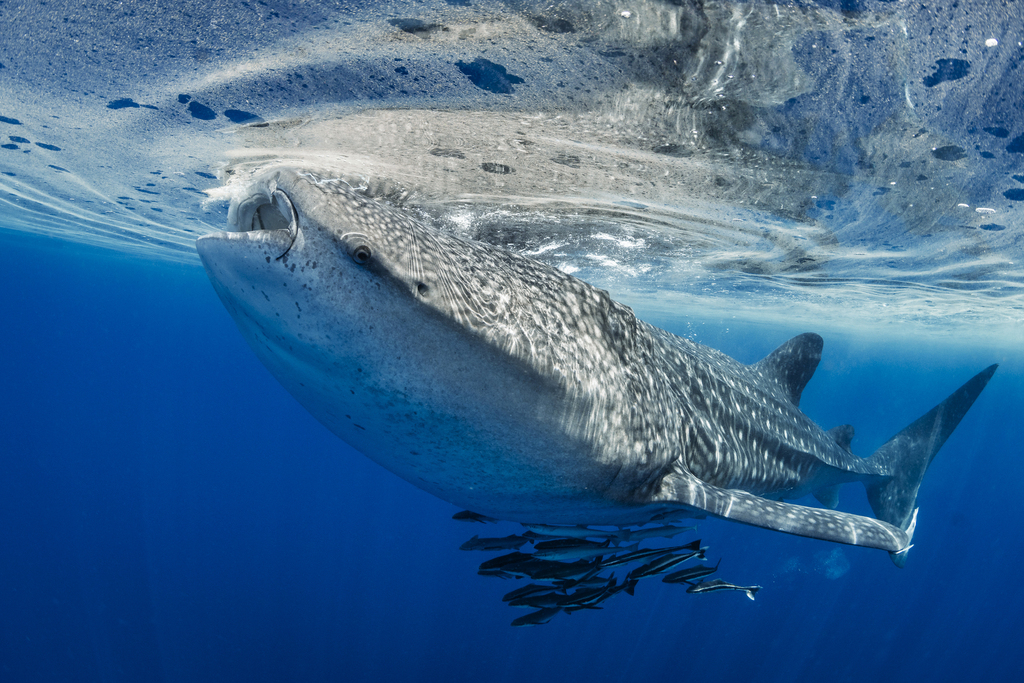
Whale Shark
Rhincodon typus
Also known as: East Indian Basking Shark
About This Species
These gentle filter-feeders congregate in productive coastal and offshore tropical waters, often drawn to aggregations of fish spawn, zooplankton blooms, or upwelling zones near continental shelves and coral atolls. Look for a broad, flattened head breaking the surface with a wide, terminal mouth agape, and the distinctive pale-spotted, checkerboard patterning on a dark grey-blue dorsal surface — the sheer scale of the animal, often exceeding 6 metres, is itself unmistakable. Prime viewing opportunities occur during predictable seasonal feeding events, such as coral spawning aggregations on Australia's Ningaloo Reef from March to July, or snapper spawning gatherings off Isla Holbox, Mexico between May and September, when calm, clear surface waters allow for reliable snorkelling encounters.
Ethical Viewing Guidelines
- Maintain a minimum distance of 3 metres from the body and 4 metres from the tail at all times, never position yourself directly in front of or beneath the animal, and avoid any physical contact whatsoever.
- As an Endangered species, it receives legal protection across much of its range, including under the U.S.
- Endangered Species Act, India's Wildlife Protection Act, Australia's Environment Protection and Biodiversity Conservation Act, and CITES Appendix II, which regulates international trade — always verify local regulations before entering the water, as some jurisdictions require licensed operators or restrict in-water encounters entirely.
- Use calm, unhurried movements, avoid flash photography, never use motorised propulsion near the animal, and immediately withdraw if it shows avoidance behaviour such as diving, accelerating, or changing direction.
Seasonal Activity
12,609 sightings · 2000–2026
Citizen science records via GBIF
Classification
- Kingdom
- Animalia
- Phylum
- Chordata
- Class
- Elasmobranchii
- Order
- Orectolobiformes
- Family
- Rhincodontidae
Photo
(c) Simon Pierce, some rights reserved (CC BY-NC), uploaded by Simon Pierce
CC-BY-NC-4.0
Occurrence data from GBIF.