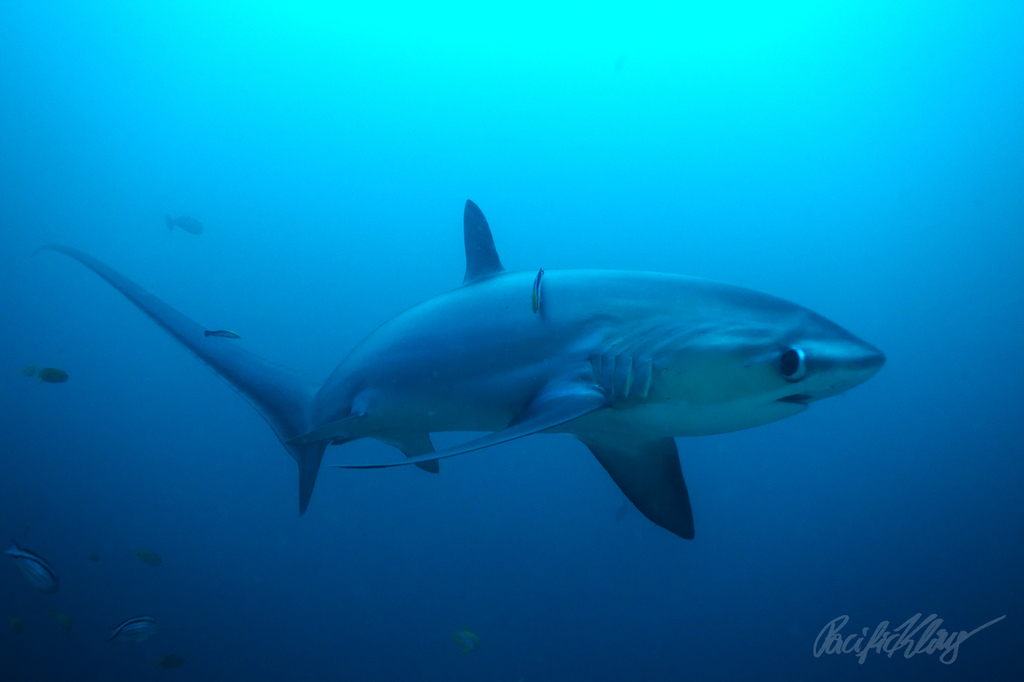
Pelagic Thresher
Alopias pelagicus
Also known as: Thresher Shark, Whiptail Shark, Pelagic Thresher Shark, Pelagic Tresher Shark, Smalltooth Thresher Shark
About This Species
Found in warm offshore waters of the Indo-Pacific, this open-ocean shark favors the epipelagic zone and is most reliably encountered around seamounts, oceanic islands, and areas of strong upwelling where prey concentrations are highest. Watch for the unmistakably elongated upper caudal lobe — roughly equal in length to the rest of the body — scything at the surface as the shark herds or stuns schooling fish, a behavior most visible in calm seas with good light penetration. Best opportunities come during liveaboard dive trips to remote Pacific sites between late spring and early autumn, when warm surface temperatures draw aggregations closer to cleaning stations and productive pelagic corridors.
Ethical Viewing Guidelines
- Maintain a minimum distance of 3–5 metres and never attempt to touch, ride, or intercept the animal's travel path, as this species is particularly sensitive to diver presence given its naturally skittish behaviour.
- Across its Indo-Pacific range, it receives varying legal protections — it is listed under CITES Appendix II restricting international trade, and national protections apply in the Philippines, Indonesia, and other range states, so research local regulations before any encounter.
- Minimise disturbance by limiting group sizes to two or three divers, avoiding flash photography, and descending slowly to depth rather than approaching from above, which can trigger flight responses in this already vulnerable species.
Seasonal Activity
306 sightings · 2000–2026
Citizen science records via GBIF
Classification
- Kingdom
- Animalia
- Phylum
- Chordata
- Class
- Elasmobranchii
- Order
- Lamniformes
- Family
- Alopiidae
Photo
(c) Klaus Stiefel, some rights reserved (CC BY-NC)
CC-BY-NC-4.0
Occurrence data from GBIF.