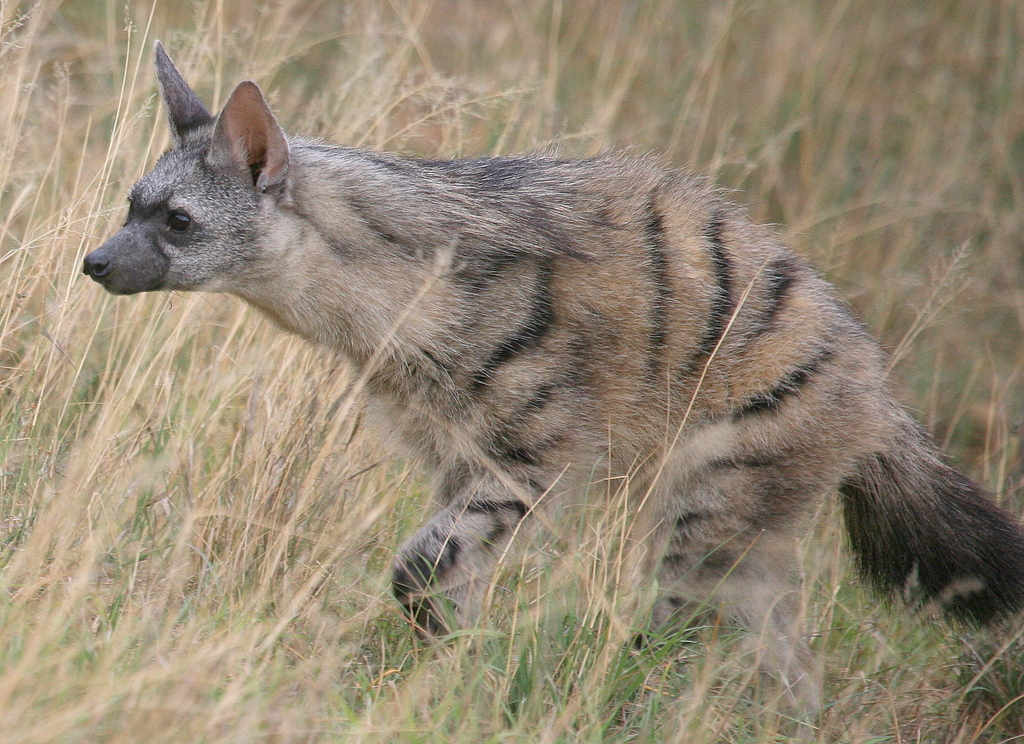
Aardwolf
Proteles cristata
Habitat
Ground
Diet
Invertebrate
Active Time
Nocturnal
Size
8.1 kg
About This Species
A solitary, insectivorous hyenid of open grasslands, scrubby savannas, and arid plains, it moves slowly across the ground at night, pausing frequently to lap up harvester termites with its broad, sticky tongue — following the seasonal abundance of *Trinervitermes* and *Microhodotermes* colonies. Watch for the characteristic sloped back, erect mane, and trotting gait in the beam of a spotlight or headlamp, and listen for a soft clucking or cackling call if two individuals encounter each other at territorial boundaries. The dry season, when termite mounds are most active and vegetation is low, offers the best sightings — patrol dirt tracks and open flats from around 21:00 onward, particularly in areas of Kalahari thornveld or East African short-grass plains.
Ethical Viewing Guidelines
- Maintain a minimum distance of 50–100 metres, using binoculars or a telephoto lens to avoid causing stress, particularly around den sites where adults are raising cubs.
- Across its range — spanning eastern and southern Africa — it is protected under national wildlife legislation in countries such as South Africa (National Environmental Management: Biodiversity Act), Kenya (Wildlife Conservation and Management Act), and Tanzania (Wildlife Conservation Act), so always ensure you hold any required permits and observe from designated areas or with licensed guides.
- Keep noise and artificial light to a minimum, especially at night when it is most active, avoid blocking its movement corridors, and never attempt to bait or lure it, as disrupting foraging behaviour can have serious consequences for its termite-dependent diet.
Seasonal Activity
618 sightings · 2000–2026
Citizen science records via GBIF
Classification
- Kingdom
- Animalia
- Phylum
- Chordata
- Class
- Mammalia
- Order
- Carnivora
- Family
- Hyaenidae
Traits
- Diet
- Invertebrate
- Foraging
- Ground
- Activity
- Nocturnal
- Body mass
- 8.1 kg
Photo
(c) Elaine Bester, some rights reserved (CC BY-NC), uploaded by Elaine Bester
CC-BY-NC-4.0
Occurrence data from GBIF.