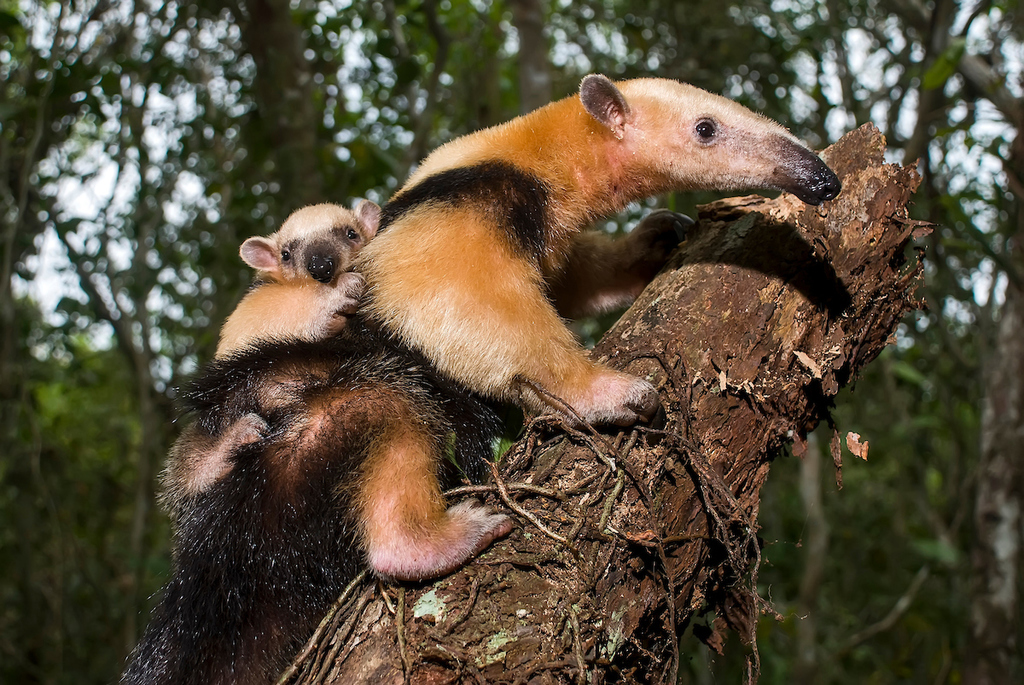
Southern Tamandua
Tamandua tetradactyla
Also known as: Collared Anteater, Golden Anteater, Lesser Anteater, Tamandua, Yellow Tamandua
About This Species
A powerful, slow-moving insectivore of forest edges, gallery forests, and open woodland, it spends time both on the ground and climbing through low branches in search of ant and termite mounds, which it tears open with robust foreclaws. Watch for the distinctive pale-and-dark vest-patterned fur and a long, tapered snout swinging close to the ground or against a tree trunk, and listen for the hissing alarm call if one feels threatened. Activity patterns vary by individual and location, but searches along forest margins and near water sources during cooler morning or late afternoon hours tend to yield the best sightings year-round.
Ethical Viewing Guidelines
- Maintain a minimum distance of 10–15 metres and use binoculars or a zoom lens to observe foraging or climbing behaviour without prompting the animal to flee or abandon a food source.
- Across its range, it is protected under Brazil's Federal Law No.
- 9.605/1998, Colombia's Law 611/2000, and CITES Appendix III (Brazil), which collectively prohibit capture, harassment, and trade, so familiarise yourself with national and local regulations before visiting.
- Keep noise to a minimum, avoid flash photography, never attempt to handle or feed individuals, and withdraw calmly if the animal raises its forelegs defensively, as this stress posture indicates you are too close.
Seasonal Activity
7,161 sightings · 2000–2026
Citizen science records via GBIF
Classification
- Kingdom
- Animalia
- Phylum
- Chordata
- Class
- Mammalia
- Order
- Pilosa
- Family
- Myrmecophagidae
Photo
(c) Instituto Últimos Refúgios, some rights reserved (CC BY-NC), uploaded by Instituto Últimos Refúgios
CC-BY-NC-4.0
Occurrence data from GBIF.