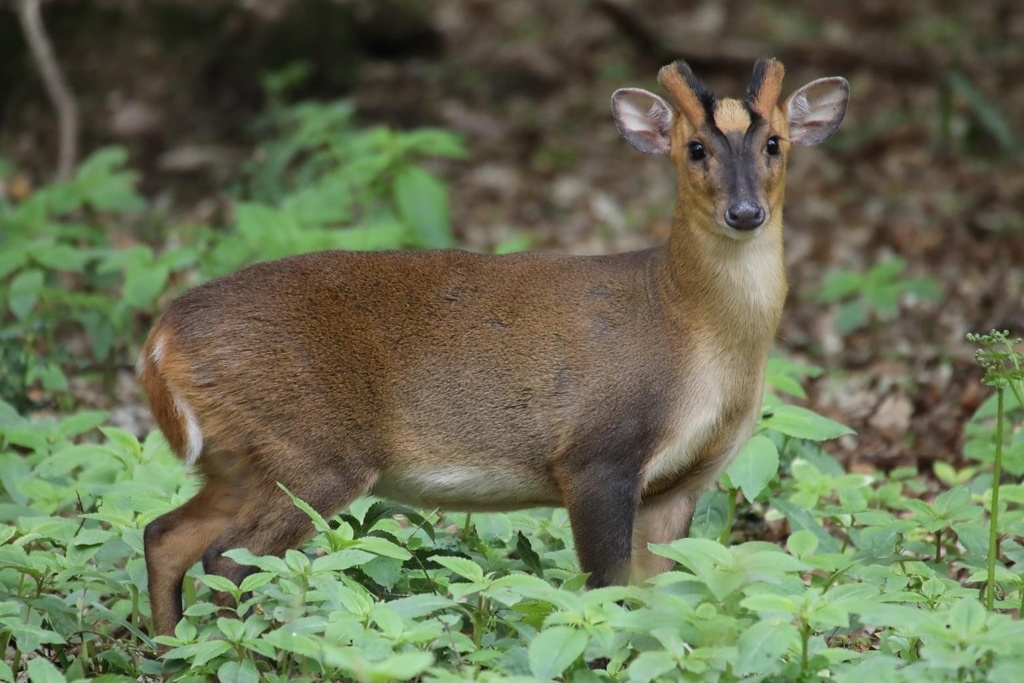
Reeves' Muntjac
Muntiacus reevesi
Also known as: Reeves's Muntjac, Chinese Muntjac, Chinese Barking Deer, Formosan Reeves' Muntjac, Muntjac
Habitat
Ground
Diet
PlantSeed
Active Time
Nocturnal
Size
13.5 kg
About This Species
A small, stocky deer native to China and Taiwan and now well established as an introduced species in parts of the UK and Europe, favouring dense woodland, scrub and overgrown gardens with thick understorey. It is mainly active at dusk, dawn and after dark, moving alone or in loose pairs and freezing or barking sharply — a sound often mistaken for a dog — when alarmed. Quiet woodland edges at first or last light, especially where undergrowth meets open ground, are the most reliable places to spot one.
Ethical Viewing Guidelines
- Keep well back and let it move away in its own time rather than following; muntjac are easily stressed by close pursuit and can react unpredictably if cornered.
- Never approach a fawn found alone, since the doe is very likely nearby and close human contact can cause abandonment.
- As an introduced species it is not subject to the same legal protections as native deer in the UK, but general animal welfare law still prohibits deliberate harassment.
Seasonal Activity
156,018 sightings · 2000–2026
Citizen science records via GBIF
Classification
- Kingdom
- Animalia
- Phylum
- Chordata
- Class
- Mammalia
- Order
- Artiodactyla
- Family
- Cervidae
Traits
- Diet
- PlantSeed
- Foraging
- Ground
- Activity
- Nocturnal
- Body mass
- 13.5 kg
- Home range
- 12 ha
Photo
(c) instead, some rights reserved (CC BY-NC)
CC-BY-NC-4.0
Occurrence data from GBIF.