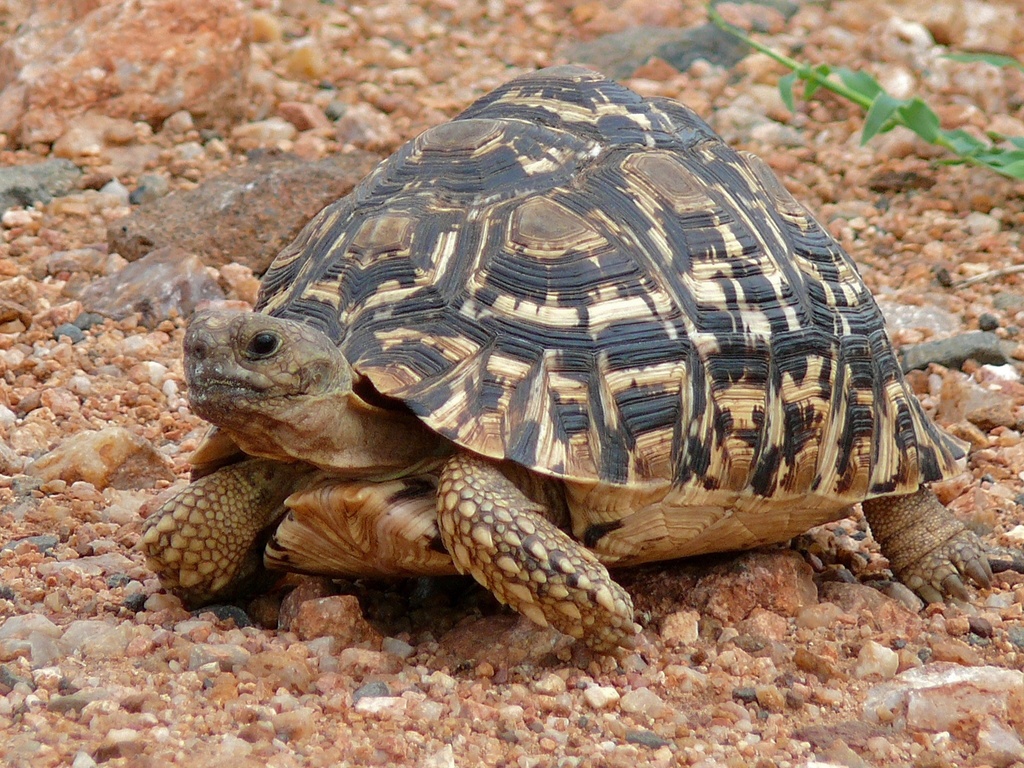
Leopard Tortoise
Stigmochelys pardalis
About This Species
Found across open savanna, grassland, and thornbush habitats throughout sub-Saharan Africa, this large terrestrial reptile spends most of its time slowly grazing on grasses, succulents, and fallen fruits, and will seek shade under shrubs or rocky outcrops during the hottest midday hours. Look for the distinctive high-domed shell with bold black-and-yellow patterning moving steadily through short grass or along track edges in the early morning, and listen for the low scraping sound of shell against vegetation or the occasional hissing exhale when the animal withdraws into its shell. The best viewing comes during the warm wet season when individuals are most active and visible in open areas, and dawn patrols along dirt roads or open plains edges are particularly productive as animals bask and forage before temperatures peak.
Ethical Viewing Guidelines
- Observe from at least 5–10 metres without approaching, circling, or blocking the animal's path, as prolonged close presence can cause stress and interrupt thermoregulation or foraging behaviour.
- Across its range in sub-Saharan Africa, it receives varying degrees of legal protection — notably under South Africa's Nature Conservation Ordinances and NEMBA, Tanzania's Wildlife Conservation Act, and internationally through CITES Appendix II, which restricts commercial trade — so never collect, handle, or remove individuals from the wild without appropriate permits.
- If encountered on a road, a single brief, careful relocation to the verge in its original direction of travel is acceptable, but otherwise keep disturbance minimal, avoid flash photography at close range, and allow the animal to move away at its own pace.
Seasonal Activity
8,887 sightings · 2000–2026
Citizen science records via GBIF
Classification
- Kingdom
- Animalia
- Phylum
- Chordata
- Class
- Testudines
- Order
- NaN
- Family
- Testudinidae
Photo
(c) Bernard DUPONT, some rights reserved (CC BY-SA)
CC-BY-SA-4.0
Occurrence data from GBIF.