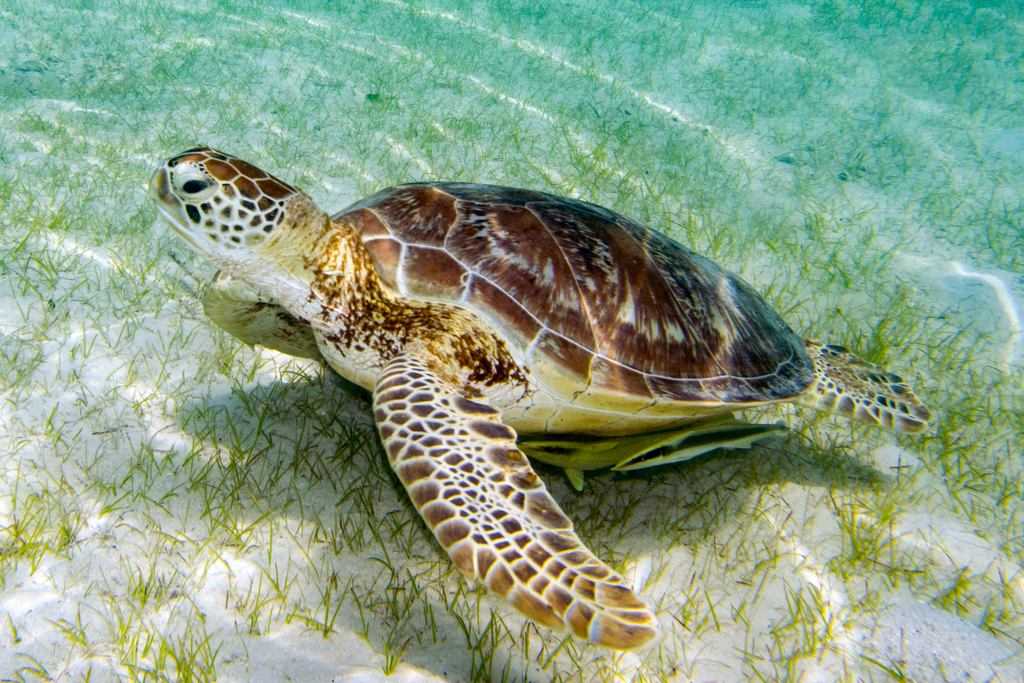
Green Turtle
Chelonia mydas
Also known as: Green Sea Turtle, Common Green Sea Turtle, Common Green Turtle, Black Turtle, Pacific Green Sea Turtle
About This Species
Snorkellers and divers encounter this large marine turtle grazing seagrass meadows and reef flats in warm coastal waters worldwide, while nesting females can be seen hauling onto tropical beaches at night in the breeding season. Juveniles favour open water and drifting algae mats before moving into shallower coastal foraging grounds as they mature. Calm, clear water over seagrass or reef is the most reliable place to watch one feeding by day.
Ethical Viewing Guidelines
- Because this species is Endangered, keep well back in the water (guidance in many marine parks is a minimum of several metres, with no touching, chasing or blocking its path to the surface) and never approach a nesting female or her tracks on the beach.
- It is protected under national laws across most of its range as well as international agreements such as CITES, and nesting beach protections vary by country, so follow local rangers or posted signage rather than assuming a single rule applies everywhere.
- Never use torches or flash photography near nesting beaches, as this disorients females and hatchlings.
Seasonal Activity
244,335 sightings · 2000–2026
Citizen science records via GBIF
Classification
- Kingdom
- Animalia
- Phylum
- Chordata
- Class
- Testudines
- Order
- NaN
- Family
- Cheloniidae
Photo
(c) Paul Asman and Jill Lenoble, some rights reserved (CC BY), uploaded by Paul Asman and Jill Lenoble
CC-BY-4.0
Occurrence data from GBIF.