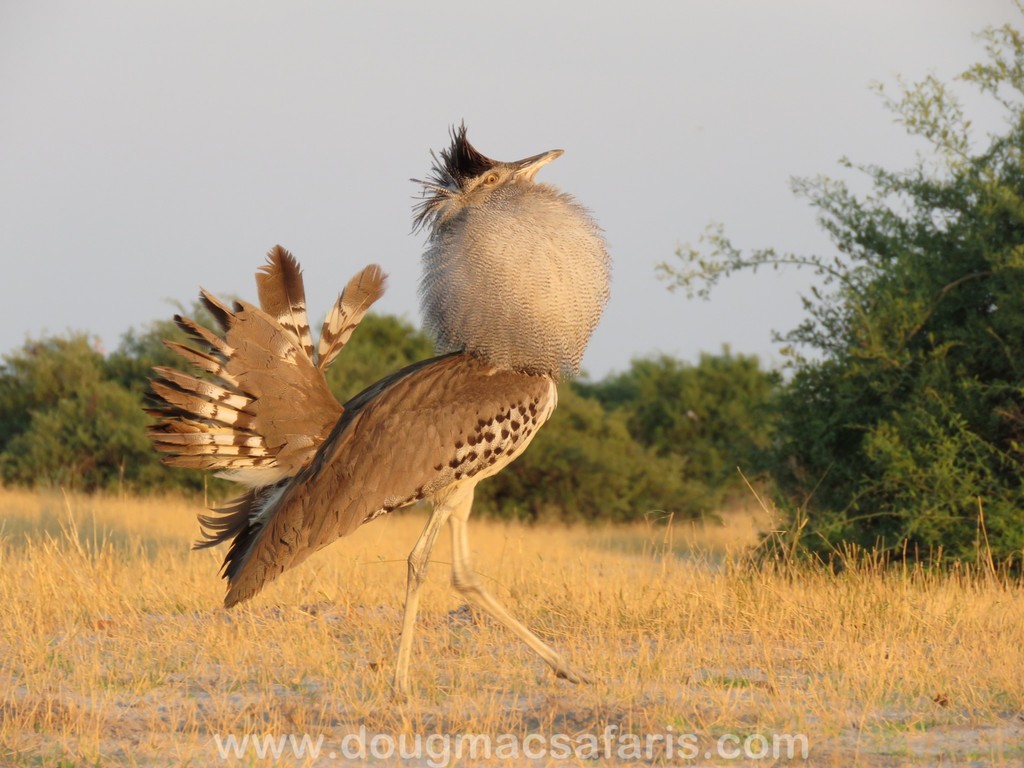
Kori Bustard
Ardeotis kori
Habitat
Ground
Diet
Omnivore
Active Time
Diurnal
Size
8.0 kg
About This Species
Look for the world's heaviest flying bird striding deliberately through open short-grass savanna, dry Kalahari scrub, or lightly grazed thornbush, often following the edges of burnt patches where invertebrates and small vertebrates are exposed. At dawn and dusk, males in display inflate their throat into a white balloon-like ruff and produce a deep, resonant booming call that carries well across flat terrain. The dry season offers the best viewing, when vegetation is low and males display most actively near territorial boundaries — scan from elevated vantage points or slow game-drive tracks during the first and last hours of light.
Ethical Viewing Guidelines
- Maintain a minimum viewing distance of 50–100 metres, using a vehicle as a hide where possible, as these birds are sensitive to human approach particularly during breeding and lekking activity.
- Across its range, it receives legal protection under national wildlife legislation in South Africa (NEMBA), Botswana, Kenya, Tanzania, and other range states, and international trade is regulated under CITES Appendix II.
- Avoid lingering near displaying or nesting individuals, keep noise and movement to a minimum, and never flush birds deliberately, as repeated disturbance can disrupt breeding behaviour and cause nest abandonment.
Seasonal Activity
46,400 sightings · 2000–2026
Citizen science records via GBIF
Classification
- Kingdom
- Animalia
- Phylum
- Chordata
- Class
- Aves
- Order
- Otidiformes
- Family
- Otididae
Traits
- Diet
- Omnivore
- Foraging
- Ground
- Activity
- Diurnal
- Body mass
- 8.0 kg
Photo
(c) Doug Macdonald, some rights reserved (CC BY-NC), uploaded by Doug Macdonald
CC-BY-NC-4.0
Occurrence data from GBIF.