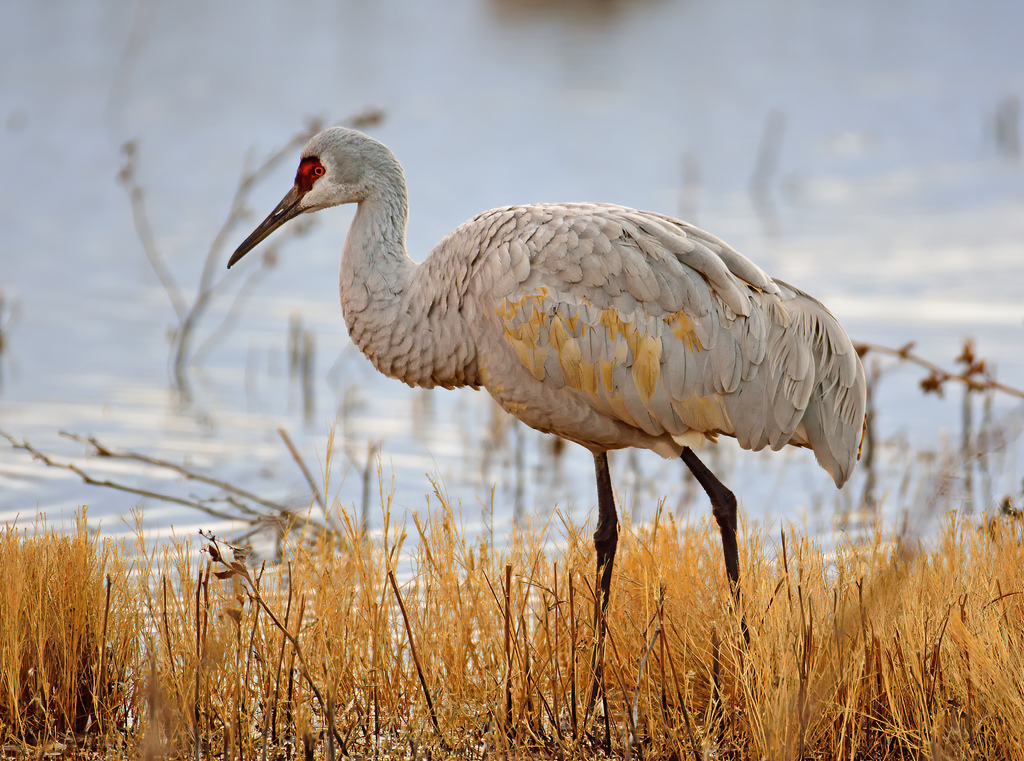
Sandhill Crane
Grus canadensis
Also known as: Fandhill Crane
Habitat
Aquatic
Diet
Omnivore
Active Time
Diurnal
Size
4.3 kg
About This Species
A tall grey crane of wet meadows, marshes and open grassland, often seen foraging in family groups on grain, roots, invertebrates and small vertebrates, and famous for its loud, rolling bugle call and elaborate leaping courtship dance. Enormous migratory concentrations gather at a handful of traditional staging wetlands, where tens of thousands of birds can be seen roosting and feeding together. Spring and autumn migration through these staging areas offer the most dramatic viewing, while breeding pairs are more scattered and secretive on wetland territories in summer.
Ethical Viewing Guidelines
- At major staging and roosting sites, viewing is normally done from designated blinds, viewing platforms or roadways at a set distance, and these limits exist for good reason given how easily large roosting flocks are flushed.
- This species is protected under wildlife law throughout its range, with migratory bird treaties covering much of the population, and disturbing nesting pairs or roost sites can carry legal penalties.
- Keeping to designated viewing areas and avoiding approaching feeding or roosting groups on foot preserves both the birds' energy reserves and the quality of the experience for other visitors.
Seasonal Activity
2,385,578 sightings · 2000–2026
Citizen science records via GBIF
Classification
- Kingdom
- Animalia
- Phylum
- Chordata
- Class
- Aves
- Order
- Gruiformes
- Family
- Gruidae
Traits
- Diet
- Omnivore
- Foraging
- Aquatic
- Activity
- Diurnal
- Body mass
- 4.3 kg
Photo
(c) Ad Konings, some rights reserved (CC BY-NC), uploaded by Ad Konings
CC-BY-NC-4.0
Occurrence data from GBIF.