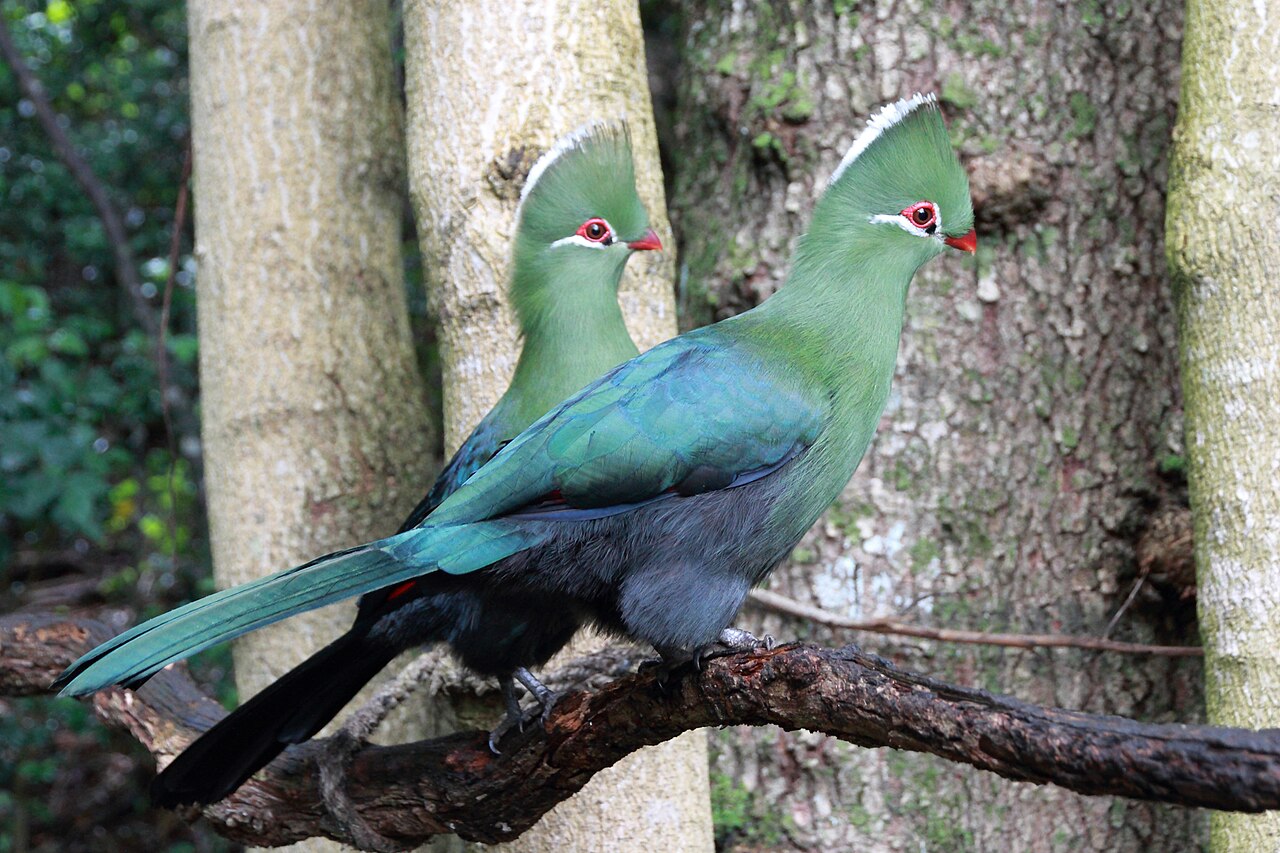
Knysna Turaco
Tauraco corythaix
Also known as: Knysna Lourie
Habitat
Mid-canopy
Diet
FruiNect
Active Time
Diurnal
Size
308 g
About This Species
Found year-round in the dense Afromontane forests of the southern and eastern Cape, this species forages actively through the mid-canopy, moving between fruiting trees with a distinctive bounding, almost clumsy flight that briefly flashes vivid crimson wing patches — an unmistakeable field marker when birds break cover. Listen for a loud, repetitive *kok-kok-kok-kok* call that carries well through closed-canopy forest, often revealing a bird before it is seen, and watch for the bold white-tipped green crest held erect when alert. Activity peaks in the early morning and again near dusk, so positioning yourself along a forest edge or near a fruiting fig or Podocarpus tree during these crepuscular windows in late summer, when fruit is most abundant, gives the best chance of prolonged, close observation.
Ethical Viewing Guidelines
- Maintain a minimum distance of 10–15 metres and use binoculars or a telephoto lens to observe without approaching active nests or roosting sites, particularly during the breeding season.
- In South Africa, the species is protected under the National Environmental Management: Biodiversity Act (NEMBA) and provincial nature conservation ordinances, which prohibit capture, harassment, or disturbance without a permit; similar protections apply within its range in Eswatini and Zimbabwe.
- Keep noise to a minimum, avoid repeated visits to the same individual or nest, and resist the temptation to use playback calls, as this can cause unnecessary stress and disrupt natural behaviours.
Seasonal Activity
33,502 sightings · 2000–2026
Citizen science records via GBIF
Classification
- Kingdom
- Animalia
- Phylum
- Chordata
- Class
- Aves
- Order
- Musophagiformes
- Family
- Musophagidae
Traits
- Diet
- FruiNect
- Foraging
- Mid-canopy
- Activity
- Diurnal
- Body mass
- 308 g
Photo
Wikimedia Commons / Wikimedia Commons
CC-BY-SA-4.0
Occurrence data from GBIF.