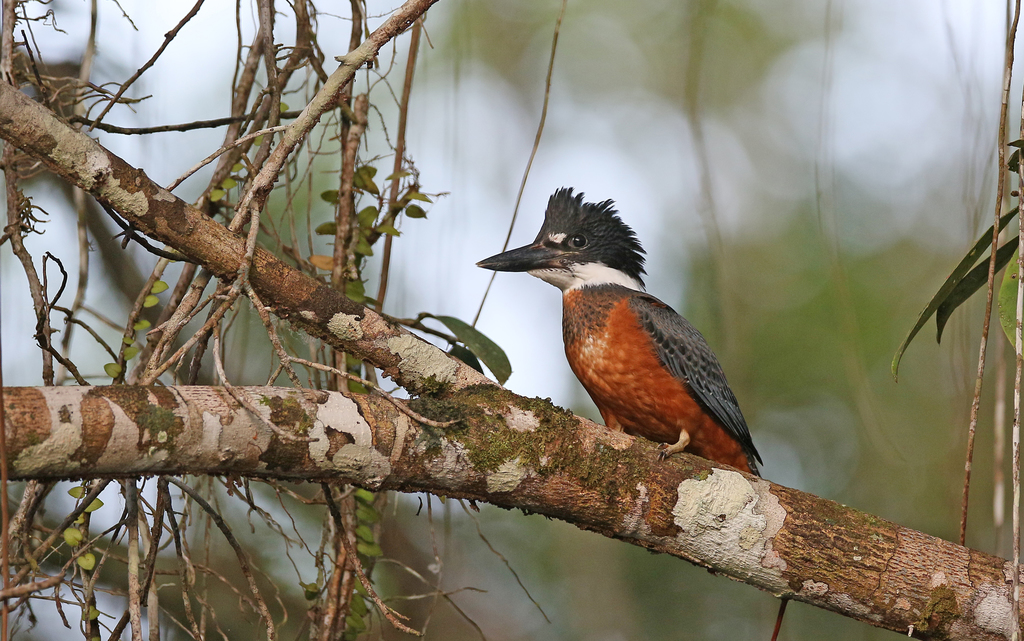
Ringed Kingfisher
Megaceryle torquata
About This Species
The largest kingfisher of the Americas, this striking, ragged-crested bird is found along rivers, lakes, and coastal lagoons from the southern United States through much of South America, where it perches on overhanging branches or wires before plunge-diving for fish. Its loud, rattling call is often the first clue to its presence, and its shaggy chestnut-and-blue-grey plumage makes it easy to identify once spotted. It is active throughout the day and can be seen year-round in suitable wetland habitat, with nesting burrows dug into earthen riverbanks during the breeding season.
Ethical Viewing Guidelines
- It generally tolerates observation from a boat or the opposite bank at a moderate distance, and approaching too closely to a perch will usually just cause it to relocate rather than cause serious harm, but repeated pursuit should be avoided.
- Nesting burrows in riverbanks are more sensitive and should not be approached or disturbed, since collapse or abandonment can result.
- Wildlife protection law differs considerably across its wide range spanning many countries, so check local regulations rather than assuming uniform protection.
Seasonal Activity
474,671 sightings · 2000–2026
Citizen science records via GBIF
Classification
- Kingdom
- Animalia
- Phylum
- Chordata
- Class
- Aves
- Order
- Coraciiformes
- Family
- Alcedinidae
Photo
(c) Christoph Moning, some rights reserved (CC BY), uploaded by Christoph Moning
CC-BY-4.0
Occurrence data from GBIF.