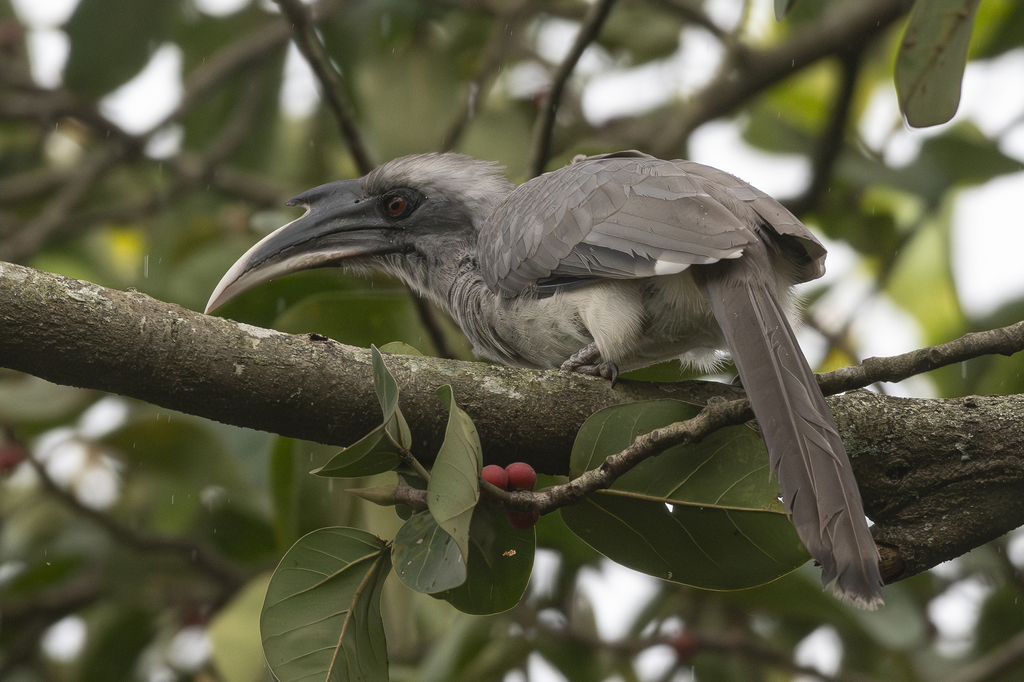
Indian Grey Hornbill
Ocyceros birostris
Also known as: Indian Gray Hornbill
About This Species
Look for this large grey-brown hornbill in open woodland, farmland edges, and even leafy town gardens across the Indian subcontinent, where it perches conspicuously on bare branches and flies with a distinctive undulating, whooshing wingbeat. It feeds mainly on figs and other fruit, along with insects and small reptiles taken from the canopy, so a fruiting fig tree at dawn or dusk is often the most reliable place to find a small group. Its loud, cackling calls carry well and usually give it away before it comes into view.
Ethical Viewing Guidelines
- Stay back at least 15-20 metres, more if a pair is nesting in a tree cavity, since hornbills are sensitive to disturbance while sealing or provisioning the nest hole.
- It is a protected species under Indian wildlife law across most of its range, so deliberate disturbance, capture or trade can carry legal penalties.
- Watch quietly from a fixed spot rather than following the bird, and use binoculars or a zoom lens instead of closing the distance.
LCAvesBucerotiformesBucerotidae
Seasonal Activity
213,703 sightings · 2000–2026
Citizen science records via GBIF
All monthsThis month
Classification
- Kingdom
- Animalia
- Phylum
- Chordata
- Class
- Aves
- Order
- Bucerotiformes
- Family
- Bucerotidae
Photo
(c) Vijay Anand Ismavel, some rights reserved (CC BY-NC)
CC-BY-NC-4.0
Occurrence data from GBIF.