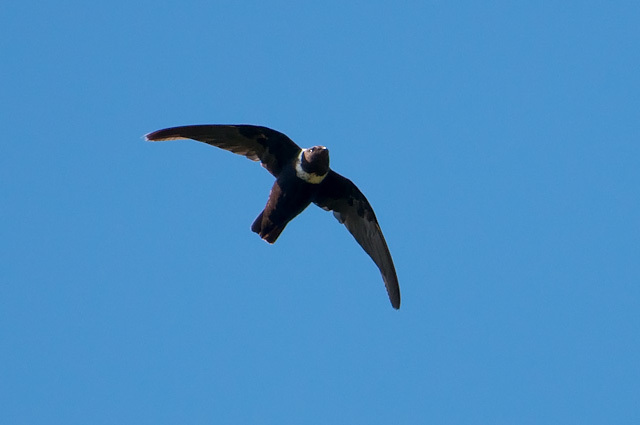
White-Collared Swift
Streptoprocne zonaris
Also known as: Collared Swift
About This Species
Watch for large flocks wheeling high overhead at dawn and dusk, foraging on the wing for flying insects with distinctive scythe-shaped wings and a shallow forked tail. Colonies roost in caves, behind waterfalls, or on cliff faces, and the mass exodus at first light or return at dusk can be spectacular where a roost is known. Warmer months, when insect activity is highest, tend to bring the largest and most active flocks.
Ethical Viewing Guidelines
- Roost sites behind waterfalls or in caves should be viewed from outside rather than entered, both because the birds can be seriously disturbed by human presence and because such sites often carry their own access hazards.
- Protections for roosting sites vary across its wide Central and South American range, and some caves are protected reserves in their own right, so check local status before visiting.
- Observing the aerial spectacle from a distance at dawn or dusk gives a full view without approaching the roost itself.
LCAvesApodiformesApodidae
Seasonal Activity
320,306 sightings · 2000–2026
Citizen science records via GBIF
All monthsThis month
Classification
- Kingdom
- Animalia
- Phylum
- Chordata
- Class
- Aves
- Order
- Apodiformes
- Family
- Apodidae
Photo
(c) Cláudio Dias Timm, some rights reserved (CC BY-NC-SA)
CC-BY-NC-SA-4.0
Occurrence data from GBIF.