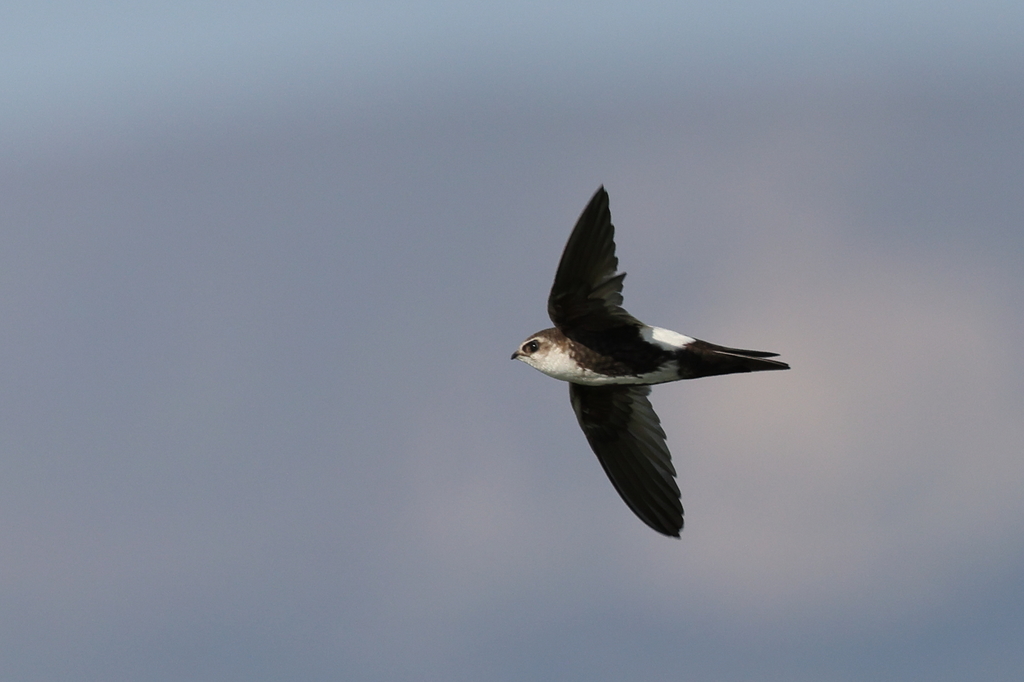
White-Throated Swift
Aeronautes saxatalis
About This Species
Scan the sky around steep cliffs, canyon walls and rocky gorges, where this swift nests in crevices and feeds entirely on the wing, often in fast, twittering groups that chase insects at height. Its scythe-like silhouette and rapid, direct flight distinguish it from swallows sharing the same airspace, and it is most conspicuous on warm afternoons in spring and summer when insect activity peaks. Watching from below a nesting cliff face, rather than approaching the rock itself, gives the best view of its aerial displays.
Ethical Viewing Guidelines
- Because this species nests on cliff faces, the main risk is disturbing a nesting colony by climbing or approaching too close to the rock rather than by proximity in open air, so keep well back from any crevice with birds entering or leaving.
- Cliff-nesting birds carry legal protection in many countries, though the specific rules differ by jurisdiction, so it is worth checking local wildlife law before climbing near an active site.
- Watching flight activity from a distance with binoculars avoids any risk of flushing birds from nest crevices.
LCAvesApodiformesApodidae
Seasonal Activity
442,025 sightings · 2000–2026
Citizen science records via GBIF
All monthsThis month
Classification
- Kingdom
- Animalia
- Phylum
- Chordata
- Class
- Aves
- Order
- Apodiformes
- Family
- Apodidae
Photo
(c) Sean P. Miller, some rights reserved (CC BY-NC), uploaded by Sean P. Miller
CC-BY-NC-4.0
Occurrence data from GBIF.