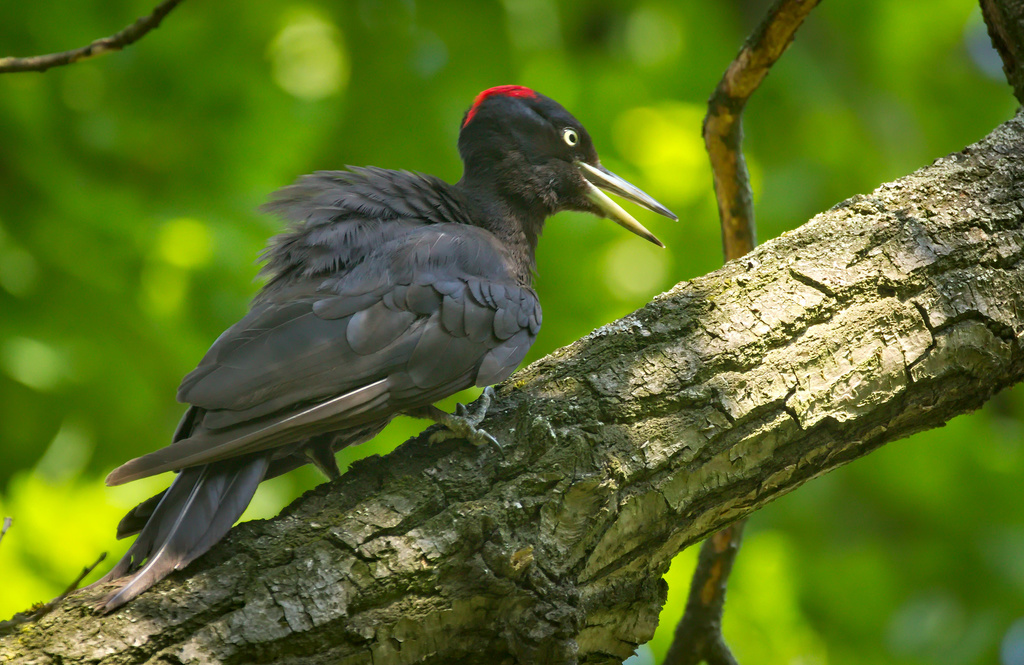
Black Woodpecker
Dryocopus martius
Habitat
Ground
Diet
Invertebrate
Active Time
Diurnal
Size
321 g
About This Species
Europe's largest woodpecker favours mature coniferous and mixed forest with large old trees, where it excavates prominent rectangular holes while searching for carpenter ants and wood-boring beetle larvae. Its loud, far-carrying drumming and ringing call are often heard well before the crow-sized, all-black bird with a red cap is seen, and listening at forest edges in early morning gives the best chance. Late winter through spring, when drumming for territory and mates peaks, is the most productive season to detect one.
Ethical Viewing Guidelines
- Observe from a distance of at least 20-30 metres and avoid approaching an active nest hole, since this species is easily flushed from nest trees and disturbance during incubation can cause desertion.
- It is a protected species under national wildlife laws across most of its European range, though specific penalties and buffer requirements vary by country, so consult local regulations before working near a known nest tree.
- Photographing or filming at the nest should only be attempted with appropriate permits where required.
Seasonal Activity
1,079,938 sightings · 2000–2026
Citizen science records via GBIF
Classification
- Kingdom
- Animalia
- Phylum
- Chordata
- Class
- Aves
- Order
- Piciformes
- Family
- Picidae
Traits
- Diet
- Invertebrate
- Foraging
- Ground
- Activity
- Diurnal
- Body mass
- 321 g
Photo
(c) hedera.baltica, some rights reserved (CC BY-SA)
CC-BY-SA-4.0
Occurrence data from GBIF.