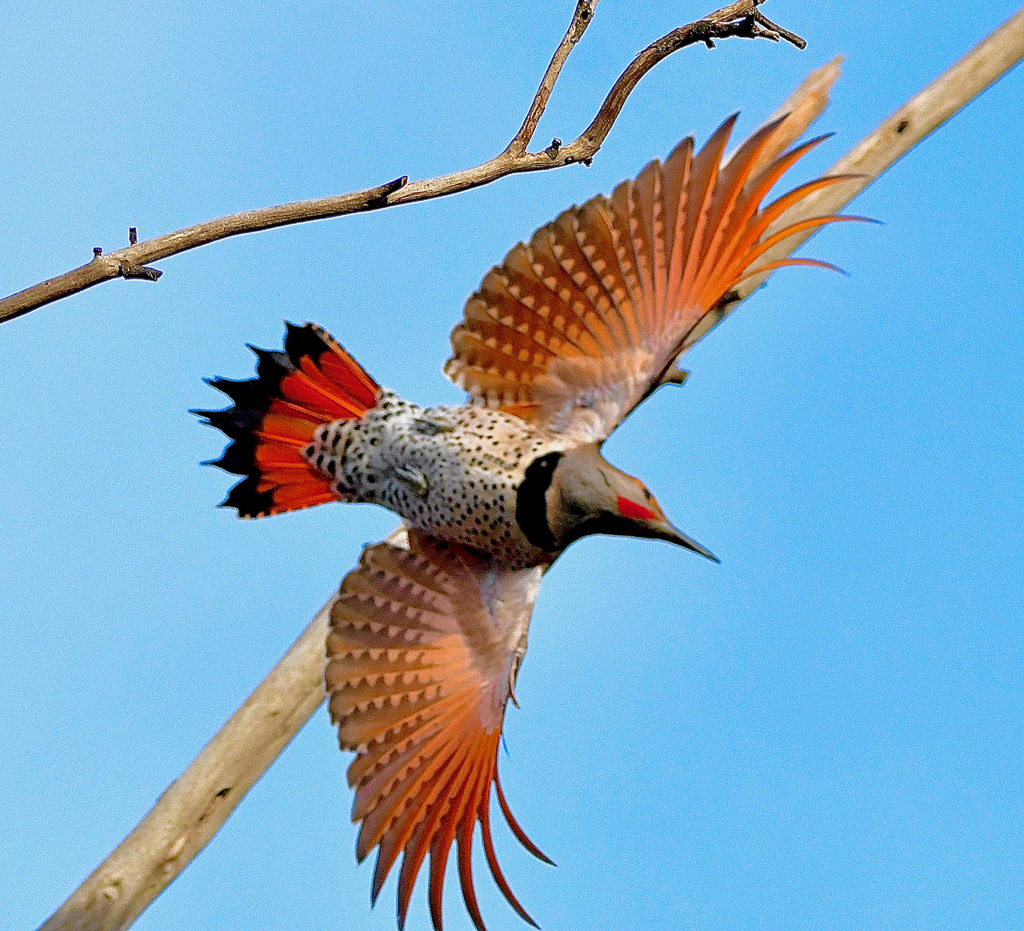
Northern Flicker
Colaptes auratus
Also known as: Common Flicker, Yellow-Shafted Flicker, Clape, Gaffer Woodpecker, Gawker Bird
About This Species
Unusually for a woodpecker, this species spends much of its time on lawns and open ground, probing for ants with its slightly curved bill rather than foraging high in trees. A flash of white rump and yellow or salmon-pink underwings is often the first clue as one flushes into flight, and its loud, ringing call carries well through open woodland edges and parks. Spring is the best time to hear the rolling drumroll males use to declare territory, often on metal gutters or hollow branches for extra volume.
Ethical Viewing Guidelines
- In the US this species is protected under the Migratory Bird Treaty Act, making it illegal to disturb active nests, eggs, or young without a permit, though enforcement and permitting details vary by country across its range.
- Nesting pairs excavate cavities in dead or dying trees, so give any nest hole a wide berth during spring and early summer and avoid lingering nearby, tapping the trunk, or using playback to draw the bird out.
- Ordinary viewing at a distance of 10 to 15 metres with binoculars is unlikely to cause disturbance outside the breeding season.
Seasonal Activity
14,369,367 sightings · 2000–2026
Citizen science records via GBIF
Classification
- Kingdom
- Animalia
- Phylum
- Chordata
- Class
- Aves
- Order
- Piciformes
- Family
- Picidae
Photo
(c) rabbitlady101, some rights reserved (CC BY-NC)
CC-BY-NC-4.0
Occurrence data from GBIF.