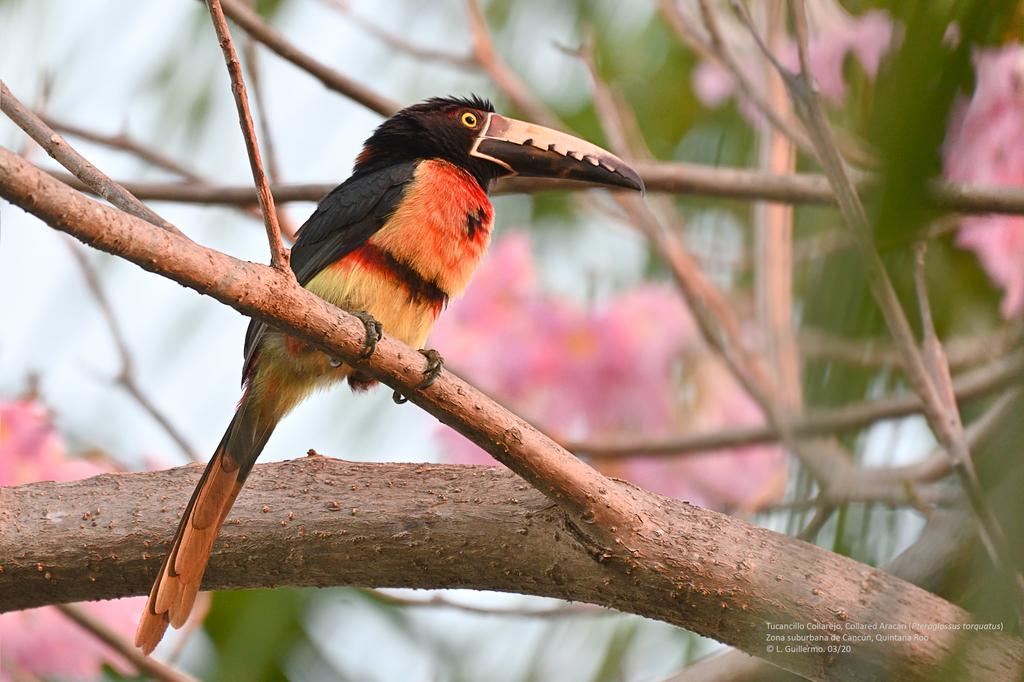
Collared Aracari
Pteroglossus torquatus
About This Species
A striking toucan relative of Central American lowland and foothill forests, it travels in small, noisy flocks through the mid to upper canopy, often heard before it is seen thanks to its sharp, squeaky calls. Look for it at fruiting trees, particularly figs, where flocks gather to feed, and its bold black-and-yellow plumage with a pale bill makes it conspicuous against green foliage once located. It is present year-round, though canopy visibility is often best during the dry season when foliage is less dense.
Ethical Viewing Guidelines
- This is a common forest species without elevated conservation concern, so observing from below at typical forest-birding distances is appropriate and does not require special caution beyond standard care not to crowd feeding flocks.
- Legal protections vary across its Central American range from Mexico to Colombia, with most countries restricting capture and trade of native wildlife, so specific rules should be checked locally rather than assumed uniform.
- Its dependence on fruiting trees means avoiding disturbance to those feeding sites is more relevant to its wellbeing than any strict viewing distance.
LCAvesPiciformesRamphastidae
Seasonal Activity
253,664 sightings · 2000–2026
Citizen science records via GBIF
All monthsThis month
Classification
- Kingdom
- Animalia
- Phylum
- Chordata
- Class
- Aves
- Order
- Piciformes
- Family
- Ramphastidae
Photo
(c) Luis Guillermo, some rights reserved (CC BY-NC), uploaded by Luis Guillermo
CC-BY-NC-4.0
Occurrence data from GBIF.