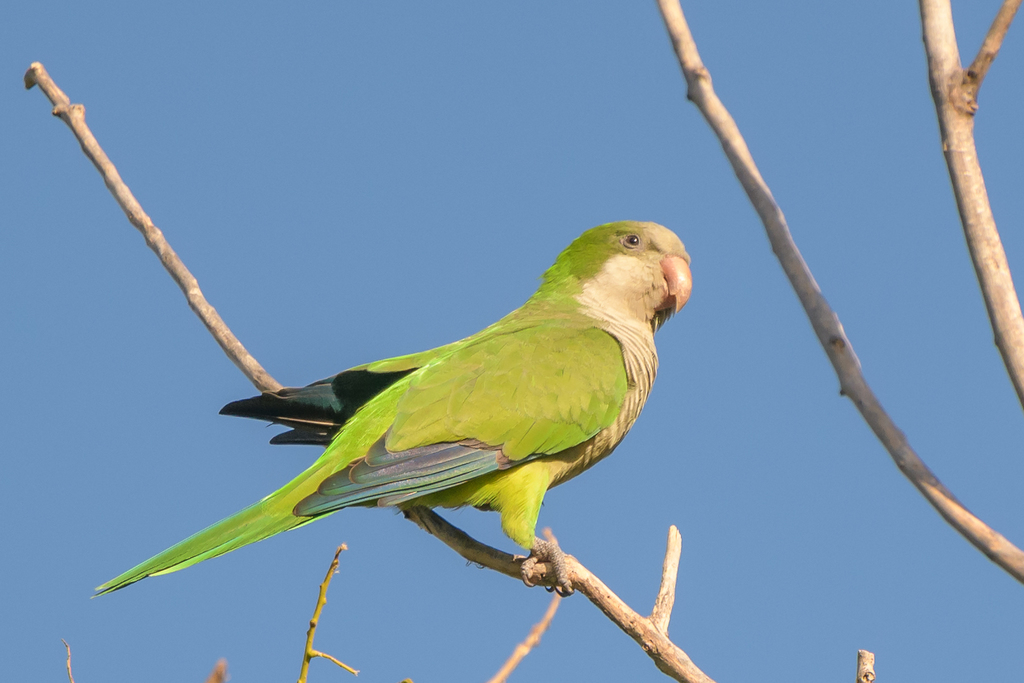
Monk Parakeet
Myiopsitta monachus
Also known as: Monk Parrakeet
Habitat
Mid-canopy
Diet
PlantSeed
Active Time
Diurnal
Size
120 g
About This Species
Look and listen for it in urban parks and suburban trees, where its harsh, chattering calls and bulky stick nests built in tree tops or on utility structures are unmistakable. Unlike most parrots, it builds a communal stick nest rather than using a cavity, and these structures are often visible year-round on tall trees or pylons. It is active by day, foraging in small noisy flocks on seeds, fruit and blossom, most visibly in early morning.
Ethical Viewing Guidelines
- Observe from a distance with binoculars rather than approaching nest structures directly, since these are often colonial and disturbance can affect multiple pairs at once.
- As a non-native species in much of its introduced range it is not always covered by the same protections as native birds, and local regulations on control or removal vary considerably by country and state, so check local rules before assuming any status.
- In its native South American range, general wildlife protection law applies as for other native species.
LCAvesPsittaciformesPsittacidae
Seasonal Activity
790,310 sightings · 2000–2026
Citizen science records via GBIF
All monthsThis month
Classification
- Kingdom
- Animalia
- Phylum
- Chordata
- Class
- Aves
- Order
- Psittaciformes
- Family
- Psittacidae
Traits
- Diet
- PlantSeed
- Foraging
- Mid-canopy
- Activity
- Diurnal
- Body mass
- 120 g
Photo
(c) Becky Matsubara, some rights reserved (CC BY)
CC-BY-4.0
Occurrence data from GBIF.