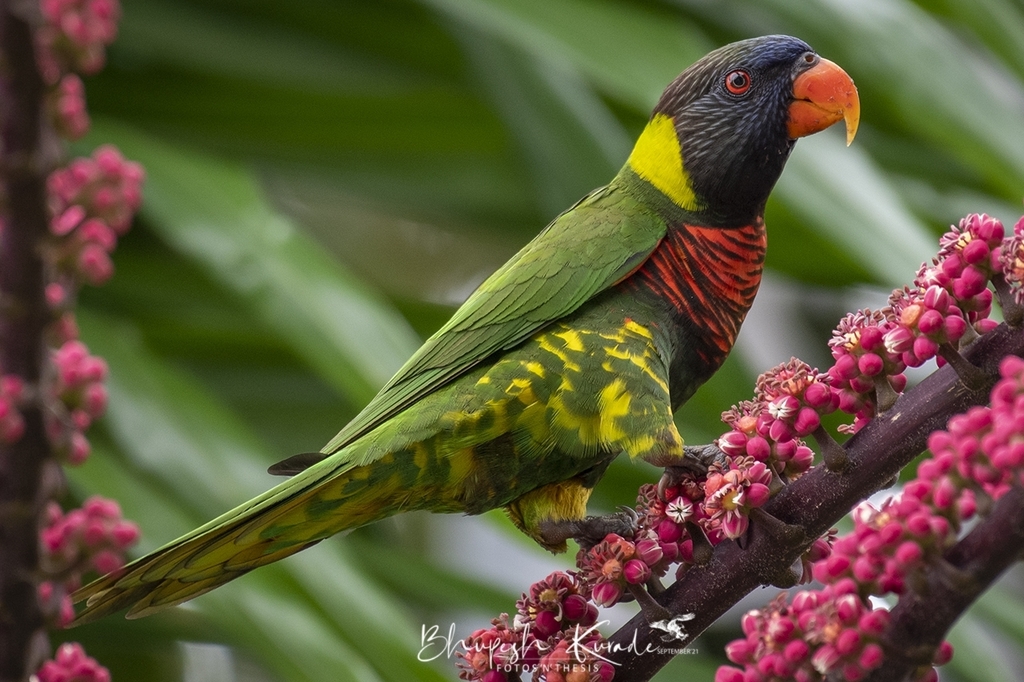
Coconut Lorikeet
Trichoglossus haematodus
Also known as: Rainbow Lorikeet, Rainbow Lory
Habitat
Understory
Diet
FruiNect
Active Time
Diurnal
Size
113 g
About This Species
Look and listen for noisy, fast-flying flocks screeching between flowering eucalyptus, banksia and coconut palms, where they cling upside down to reach nectar and pollen. Dawn and dusk are the most active feeding times, when groups gather in blossoming canopy trees across northern Australia, New Guinea and eastern Indonesia. Bright plumage flashes of red, green and blue are easiest to pick out against pale flowers rather than dense foliage.
Ethical Viewing Guidelines
- Stay back at least 10 to 15 metres from feeding or nesting trees and avoid approaching hollow-bearing trees, which pairs reuse for nesting.
- Protections vary by country across its Australasian and Southeast Asian range, so check local wildlife regulations rather than assuming a single standard applies.
- Avoid supplementary feeding that draws large flocks into unnatural concentrations, since this can spread disease between birds.
Seasonal Activity
1,528,282 sightings · 2000–2026
Citizen science records via GBIF
Classification
- Kingdom
- Animalia
- Phylum
- Chordata
- Class
- Aves
- Order
- Psittaciformes
- Family
- Psittacidae
Traits
- Diet
- FruiNect
- Foraging
- Understory
- Activity
- Diurnal
- Body mass
- 113 g
Photo
(c) Dipika n Bhupesh Kurade, some rights reserved (CC BY-NC), uploaded by Dipika n Bhupesh Kurade
CC-BY-NC-4.0
Occurrence data from GBIF.