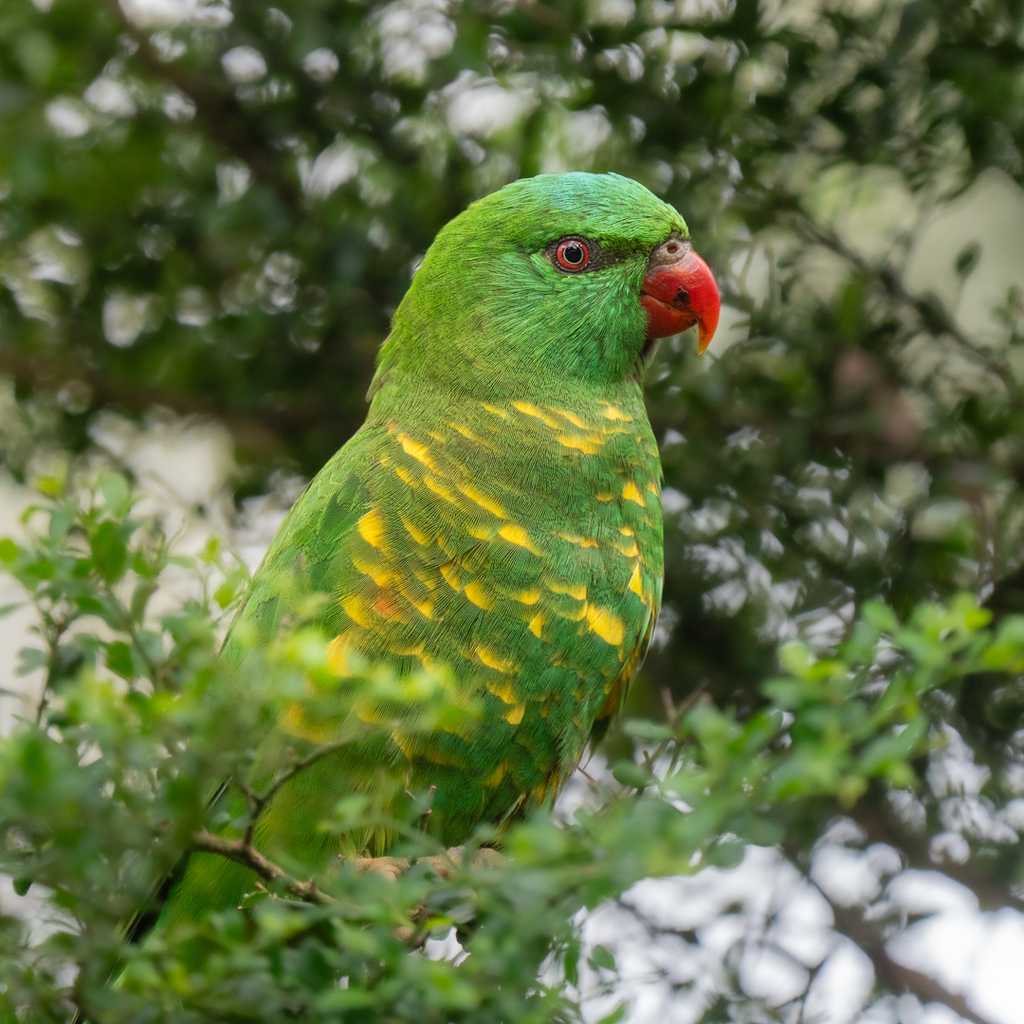
Scaly-Breasted Lorikeet
Trichoglossus chlorolepidotus
About This Species
This noisy, brightly coloured lorikeet travels in fast, chattering flocks and is best located by sound before sight, especially around flowering eucalypts, grevilleas and fruiting trees where it feeds on nectar and pollen. It favours open forest, woodland and increasingly urban parks and gardens across eastern Australia. Dawn and dusk gatherings at flowering trees or communal roosts offer the most reliable viewing.
Ethical Viewing Guidelines
- Native parrots including this species are protected under Australian state legislation, which prohibits capture, harm or nest disturbance; keep a comfortable distance of several metres from feeding or roosting flocks and never attempt to feed or handle wild birds.
- Avoid disturbing tree hollows, which are used for nesting and are often in short supply.
- Watching quietly from below a feeding tree is usually sufficient for good views without causing flocks to scatter.
LCAvesPsittaciformesPsittacidae
Seasonal Activity
197,881 sightings · 2000–2026
Citizen science records via GBIF
All monthsThis month
Classification
- Kingdom
- Animalia
- Phylum
- Chordata
- Class
- Aves
- Order
- Psittaciformes
- Family
- Psittacidae
Photo
(c) Nicole Brooker, some rights reserved (CC BY-NC), uploaded by Nicole Brooker
CC-BY-NC-4.0
Occurrence data from GBIF.