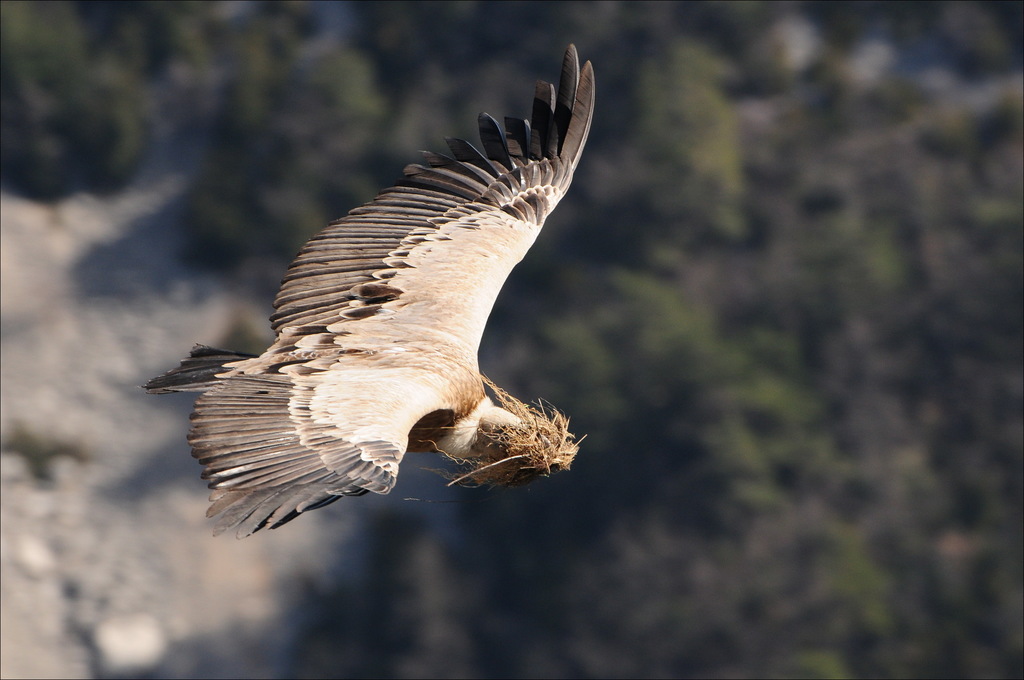
Griffon Vulture
Gyps fulvus
Also known as: Eurasian Griffon Vulture, Eurasian Griffon, European Griffon Vulture
Habitat
Ground
Diet
VertFishScav
Active Time
Diurnal
Size
7.4 kg
About This Species
This large vulture soars on broad wings over mountains, cliffs and open plains, often in groups riding thermals as it searches for carrion. Its pale, sandy-brown plumage and pale head contrast with dark flight feathers, and it is most easily observed circling near cliff nesting colonies or descending to feed at carcasses. Warm, clear days with strong thermals, typically in mid-morning through afternoon, offer the best soaring flight views.
Ethical Viewing Guidelines
- Observe nesting cliffs from a distance with a scope or binoculars rather than approaching ledges, since vultures can abandon nests if disturbed during incubation or when young are still dependent.
- This species is protected under wildlife law across most of its European, African and Asian range, though the specific statutes and enforcement differ by country.
- Never approach a carcass where vultures are feeding, both to avoid disturbing the birds and for personal safety around large scavenging groups.
Seasonal Activity
1,568,801 sightings · 2000–2026
Citizen science records via GBIF
Classification
- Kingdom
- Animalia
- Phylum
- Chordata
- Class
- Aves
- Order
- Accipitriformes
- Family
- Accipitridae
Traits
- Diet
- VertFishScav
- Foraging
- Ground
- Activity
- Diurnal
- Body mass
- 7.4 kg
Photo
(c) Philippe Macquet, some rights reserved (CC BY-NC-SA)
CC-BY-NC-SA-4.0
Occurrence data from GBIF.