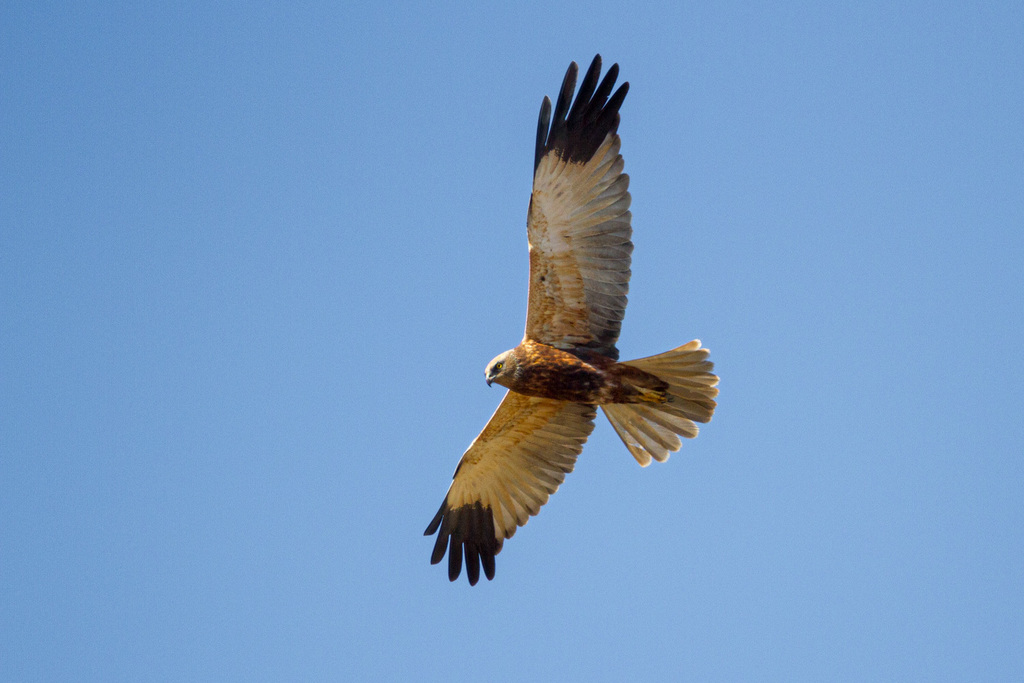
Western Marsh Harrier
Circus aeruginosus
Also known as: Eurasian Marsh Harrier, Marsh Harrier, Arpella Vulgar
Habitat
Ground
Diet
VertFishScav
Active Time
Diurnal
Size
704 g
About This Species
This large raptor hunts low over reedbeds and wetland margins with a slow, tilting flight, wings held in a shallow V as it scans for small mammals, birds and eggs. Early morning and late afternoon are the most active hunting periods, and reedbed reserves with open water are the most reliable places to watch it quarter the ground. Breeding pairs perform dramatic aerial food passes in spring, a memorable sight for anyone watching from a hide.
Ethical Viewing Guidelines
- Nesting birds are highly sensitive to disturbance near their reedbed nest sites, so viewing from a hide or designated path well back from breeding areas is important, particularly during the spring nesting season.
- This species and its nest are legally protected across much of its European range, though the strength of protection and penalties for disturbance vary by country.
- Avoid entering reedbeds during the breeding season, and let the bird's own behaviour, not proximity, guide how close is too close.
Seasonal Activity
3,128,016 sightings · 2000–2026
Citizen science records via GBIF
Classification
- Kingdom
- Animalia
- Phylum
- Chordata
- Class
- Aves
- Order
- Accipitriformes
- Family
- Accipitridae
Traits
- Diet
- VertFishScav
- Foraging
- Ground
- Activity
- Diurnal
- Body mass
- 704 g
Photo
(c) Artem Kuznetsov, some rights reserved (CC BY), uploaded by Artem Kuznetsov
CC-BY-4.0
Occurrence data from GBIF.