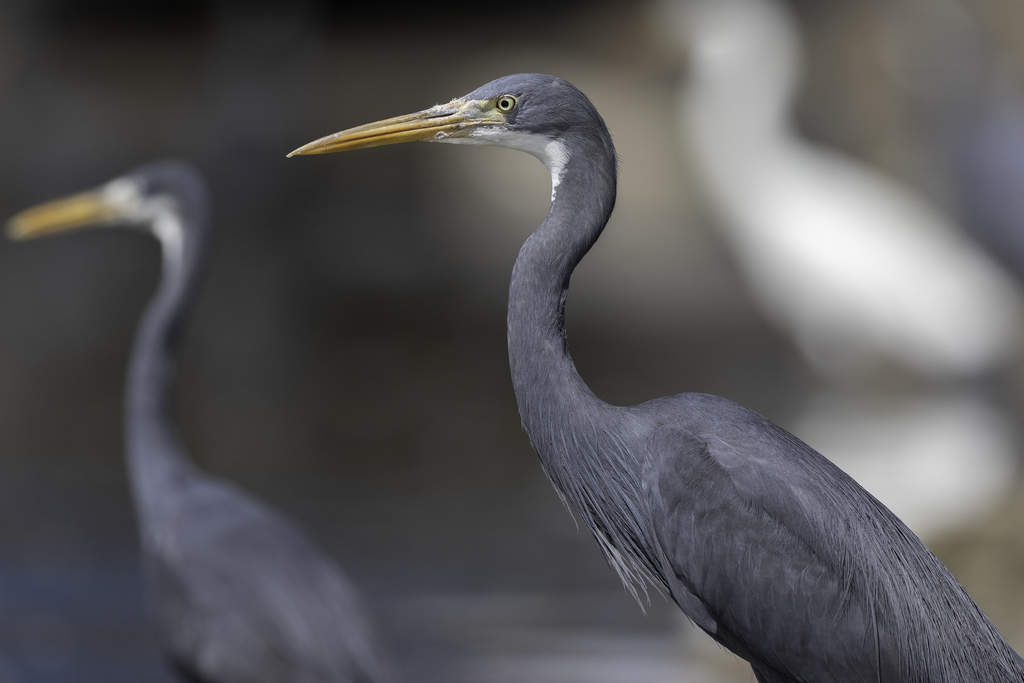
Western Reef-Heron
Egretta gularis
Also known as: Western Reef-Egret, Reef Heron, Wrhe
About This Species
Found along rocky coastlines, tidal mudflats, mangrove edges, and sandy beaches, this patient stalker typically stands motionless at the water's edge or wades slowly through shallow tidal pools waiting to strike at fish, crustaceans, and invertebrates. It occurs in two distinct color morphs — a dark slaty-grey form and an all-white form that can be confused with Little Egret, so look closely for the diagnostic yellow-based bill that is heavier and more decurved, along with yellowish feet rather than the bright yellow toes of that similar species. Low tide on calm mornings provides the best opportunities, as retreating water concentrates prey and draws birds into open, easily observable feeding areas; along the West African coast and the Persian Gulf region, the resident population can be approached steadily with patience, while wintering birds in South Asia tend to be more skittish.
Ethical Viewing Guidelines
- Maintain a minimum distance of 10–15 metres when observing this species, increasing significantly if birds show signs of alertness, such as raised posture or ceasing foraging.
- Across its range — spanning West Africa, the Red Sea, Persian Gulf, and South Asian coasts — it is protected under national wildlife legislation in countries including India (Wildlife Protection Act, 1972), the UAE, and various West African states, as well as through international frameworks such as the African-Eurasian Waterbird Agreement (AEWA).
- Approach slowly from a low profile, avoid disturbing roosting or nesting sites, and keep noise to a minimum, particularly during breeding season when repeated disturbance can cause nest abandonment.
Seasonal Activity
96,984 sightings · 2000–2026
Citizen science records via GBIF
Classification
- Kingdom
- Animalia
- Phylum
- Chordata
- Class
- Aves
- Order
- Pelecaniformes
- Family
- Ardeidae
Photo
(c) amolmm, some rights reserved (CC BY-NC), uploaded by amolmm
CC-BY-NC-4.0
Occurrence data from GBIF.