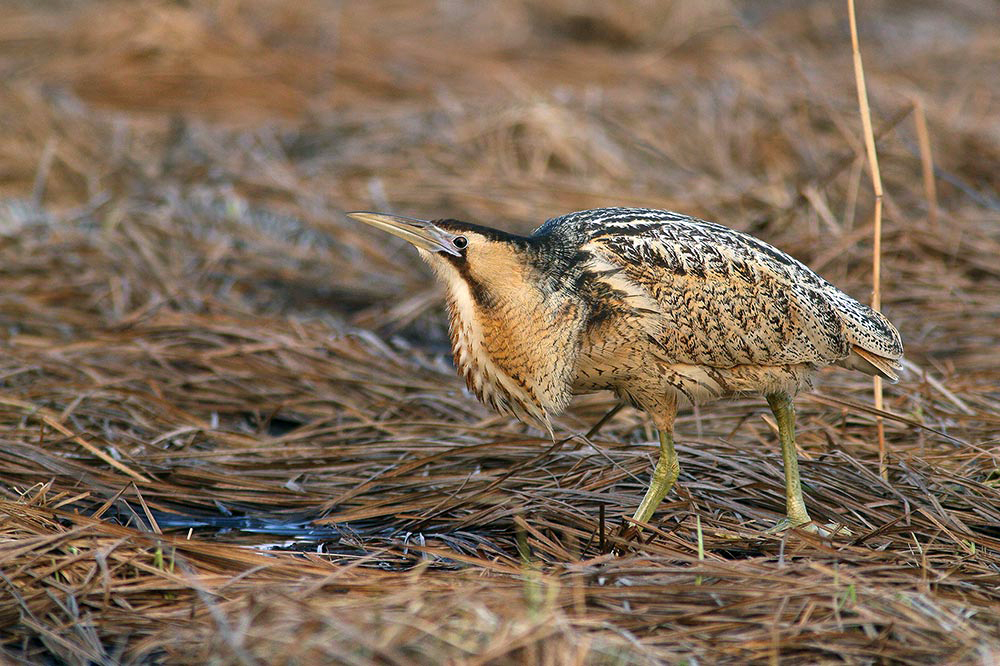
Eurasian Bittern
Botaurus stellaris
Also known as: Great Bittern, Bittern, Common Bittern
Habitat
Aquatic
Diet
VertFishScav
Active Time
Diurnal
Size
1.3 kg
About This Species
Search dense reedbeds and marsh vegetation at the edges of lakes and wetlands, where this heron's superb camouflage and habit of freezing with its bill pointed skyward make it far easier to hear than see. The deep, booming call carried by males in spring is often the first sign of its presence, audible over long distances at dawn and dusk during the breeding season. Patient watching from a hide overlooking a reedbed edge, especially in early morning, gives the best chance of seeing one emerge to hunt along the margins.
Ethical Viewing Guidelines
- Keep a generous distance from reedbeds where a bittern is calling or has been seen, since this is a shy, easily disturbed species that will retreat deeper into cover rather than tolerate close approach, and playback of its call to draw a response is best avoided during the breeding season.
- Reedbed and wetland habitat, along with the birds using it, is legally protected in much of its European and Asian range, though the strength of that protection and any access restrictions vary by country, so check local rules before entering reedbed habitat.
- Staying on paths or boardwalks around wetland reserves, rather than pushing into reeds for a view, protects both the bird and its breeding habitat.
Seasonal Activity
427,132 sightings · 2000–2026
Citizen science records via GBIF
Classification
- Kingdom
- Animalia
- Phylum
- Chordata
- Class
- Aves
- Order
- Pelecaniformes
- Family
- Ardeidae
Traits
- Diet
- VertFishScav
- Foraging
- Aquatic
- Activity
- Diurnal
- Body mass
- 1.3 kg
Photo
(c) Tatyana Zarubo, some rights reserved (CC BY-NC), uploaded by Tatyana Zarubo
CC-BY-NC-4.0
Occurrence data from GBIF.