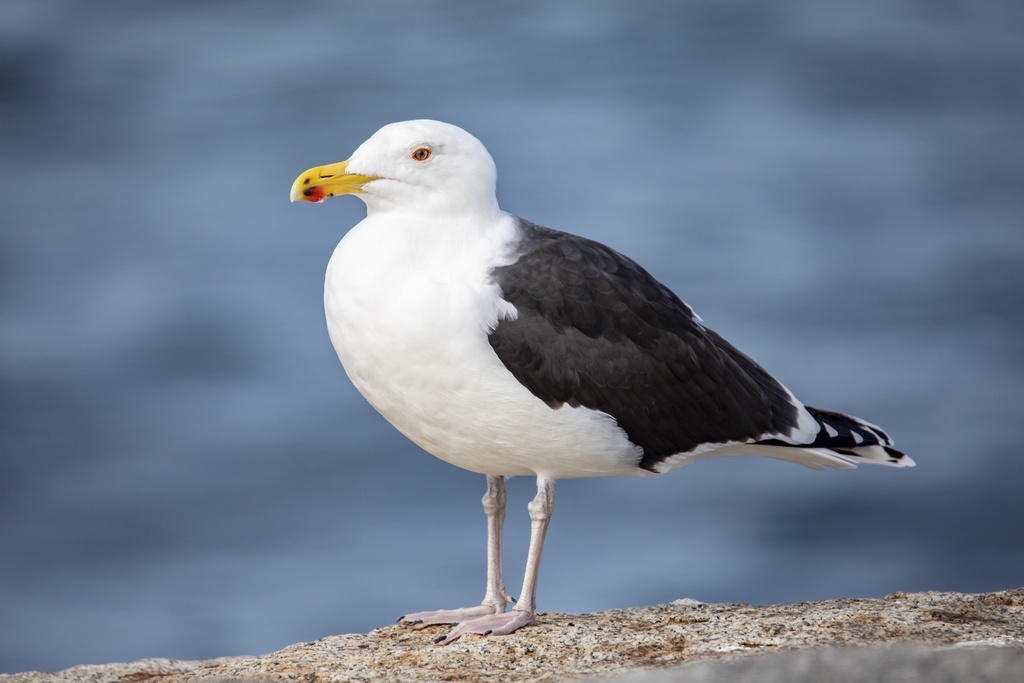
Great Black-Backed Gull
Larus marinus
Also known as: Greater Black-Backed Gull
Habitat
Ground
Diet
Omnivore
Active Time
Diurnal
Size
1.6 kg
About This Species
The largest gull in the North Atlantic region, this powerful black-backed bird is found along rocky coasts, harbours and estuaries, where it forages on the ground and in shallow water and will readily scavenge or take eggs and chicks of other seabirds. Its deep, gruff call and commanding size make it easy to pick out among mixed gull flocks, particularly around fishing harbours and refuse sites where food is abundant. Cliff and island breeding colonies are most active and visible in late spring and summer.
Ethical Viewing Guidelines
- Adults defending nests or chicks on cliffs and islands can become aggressive toward anyone approaching too closely, so keeping well back from breeding colonies protects both visitors and the birds.
- In the United Kingdom and across much of Europe wild birds and their nests are protected under national wildlife legislation, and in North America under the Migratory Bird Treaty Act, though specific rules on colony access vary by country and site.
- Avoiding coastal paths near colonies during the breeding season reduces the risk of adults abandoning nests under repeated disturbance.
Seasonal Activity
4,479,779 sightings · 2000–2026
Citizen science records via GBIF
Classification
- Kingdom
- Animalia
- Phylum
- Chordata
- Class
- Aves
- Order
- Charadriiformes
- Family
- Laridae
Traits
- Diet
- Omnivore
- Foraging
- Ground
- Activity
- Diurnal
- Body mass
- 1.6 kg
Photo
(c) Alex Shure, some rights reserved (CC BY-NC), uploaded by Alex Shure
CC-BY-NC-4.0
Occurrence data from GBIF.