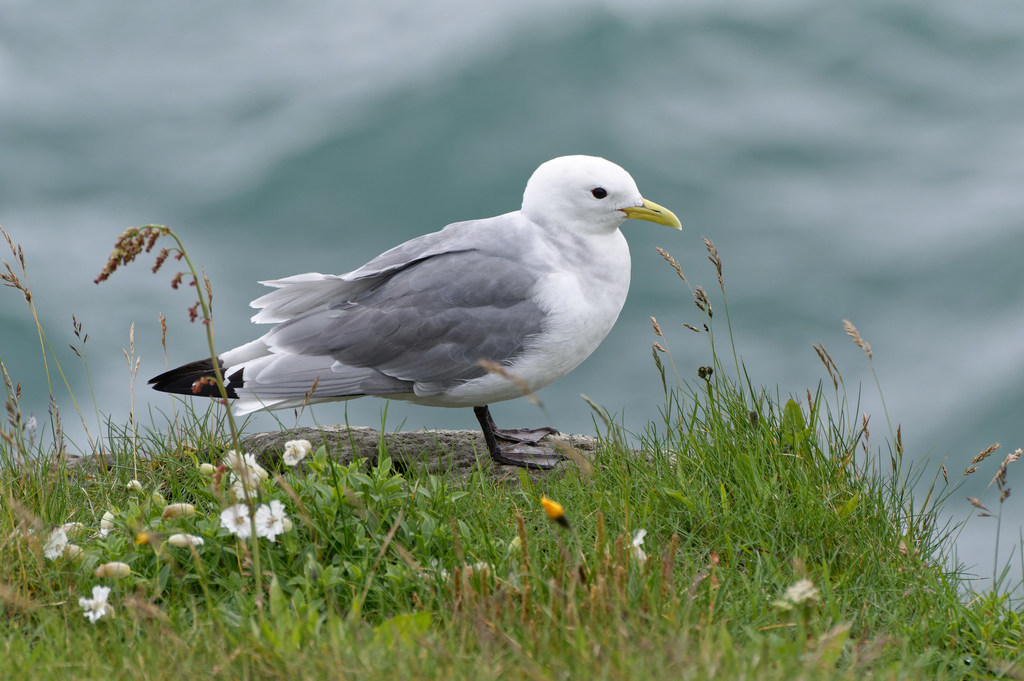
Black-Legged Kittiwake
Rissa tridactyla
Also known as: Kittiwake, Kittiwake Gull
Habitat
Aquatic
Diet
Omnivore
Active Time
Diurnal
Size
416 g
About This Species
Look for dense, noisy colonies on narrow sea-cliff ledges around the North Atlantic and North Pacific, where this small, dainty gull nests in closer proximity to its neighbours than most seabirds. Its name echoes its distinctive, rhythmic call, and outside the breeding season it becomes almost entirely pelagic, ranging far out to sea and rarely seen from land. The breeding season, from late spring into summer, offers by far the most reliable and spectacular viewing at established cliff colonies.
Ethical Viewing Guidelines
- Because this species is Vulnerable and its colonies are concentrated at a limited number of cliff sites, viewing should be from clifftop paths or boats kept well back rather than approaching ledges directly, and any sign of birds flushing from nests means backing off immediately.
- Seabird colonies are legally protected in many North Atlantic countries, including restrictions on approach during the breeding season, though the exact rules differ by country and site, so check local guidance before visiting a colony.
- Disturbance at a kittiwake colony can cause eggs or chicks to be knocked from ledges or taken by predatory gulls, so this is a species where extra caution is warranted rather than optional.
Seasonal Activity
647,732 sightings · 2000–2026
Citizen science records via GBIF
Classification
- Kingdom
- Animalia
- Phylum
- Chordata
- Class
- Aves
- Order
- Charadriiformes
- Family
- Laridae
Traits
- Diet
- Omnivore
- Foraging
- Aquatic
- Activity
- Diurnal
- Body mass
- 416 g
Photo
(c) Donald Davesne, some rights reserved (CC BY), uploaded by Donald Davesne
CC-BY-4.0
Occurrence data from GBIF.