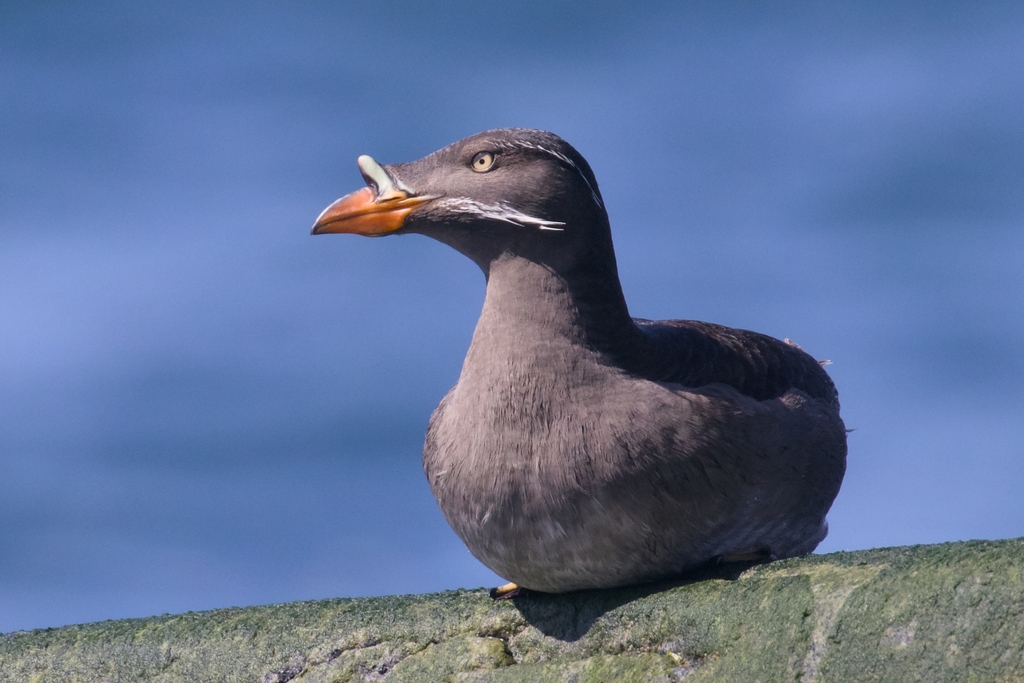
Rhinoceros Auklet
Cerorhinca monocerata
Also known as: Horned-Billed Guillemot, Rhinoceros Puffin
About This Species
This North Pacific seabird spends the day far offshore diving for small fish and only returns to its breeding colonies under cover of darkness, so daytime views are usually limited to birds bobbing on open water or flying low over waves near the coast. Breeding adults grow a pale, upright bill plate that gives the species its name, visible at close range from a boat. Dusk boat trips near known colonies in spring and summer, or seawatching from headlands during migration, offer the best chances.
Ethical Viewing Guidelines
- Because colonies are nocturnal and burrow-based, the greatest risk of disturbance comes from visiting nesting islands after dark with lights or noise, which can cause adults to abandon burrows, so such visits should be avoided unless part of a permitted research or guided programme.
- Marine wildlife protections and seabird colony access rules vary between Canada, the United States and other range states, so check local regulations rather than assuming a single standard applies.
- Watching from a boat at a distance that does not alter the birds' flight or diving behaviour is the safest general approach.
Seasonal Activity
261,252 sightings · 2000–2026
Citizen science records via GBIF
Classification
- Kingdom
- Animalia
- Phylum
- Chordata
- Class
- Aves
- Order
- Charadriiformes
- Family
- Alcidae
Photo
(c) Anastasiia Merkulova, some rights reserved (CC BY-NC), uploaded by Anastasiia Merkulova
CC-BY-NC-4.0
Occurrence data from GBIF.