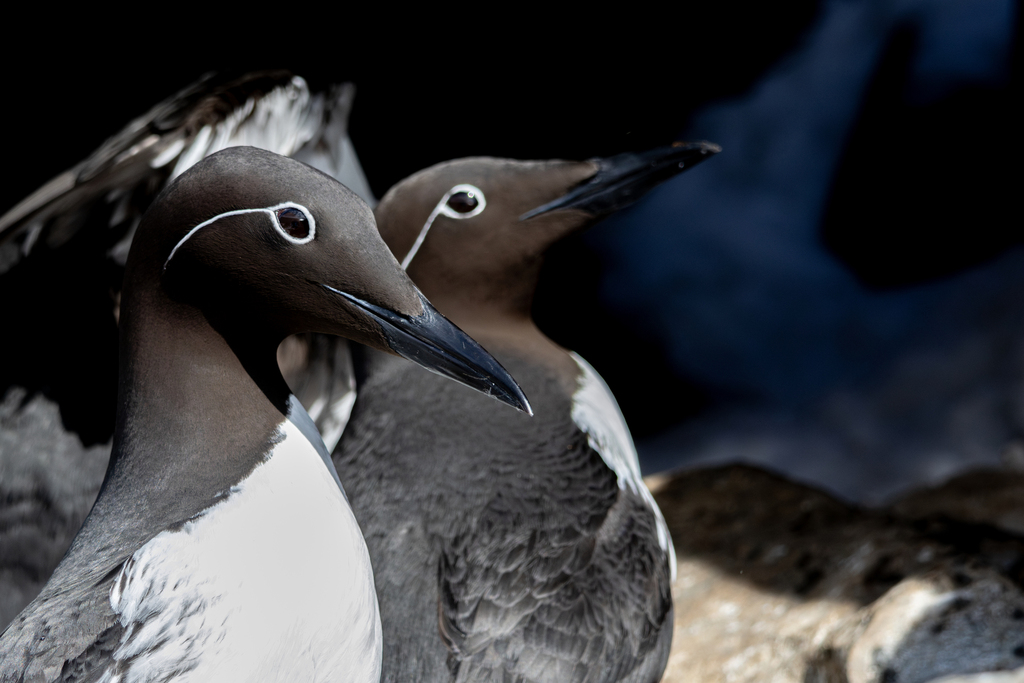
Common Murre
Uria aalge
Also known as: Common Guillemot, Guillemot, Northern Guillemot, Atlantic Murre
Habitat
Aquatic
Diet
VertFishScav
Active Time
Diurnal
Size
992 g
About This Species
This diving seabird breeds in dense colonies on sea cliffs and rocky islands across the North Atlantic and North Pacific, packing tightly onto narrow ledges. Look for its upright, penguin-like stance and listen for a constant, growling chorus from the colony, and watch for birds diving and swimming underwater in pursuit of fish just offshore. The breeding season, spring into summer, is the best time to see large numbers gathered at colonies, while winter birds are more scattered at sea.
Ethical Viewing Guidelines
- Cliff colonies are sensitive to disturbance, since a startled flush can dislodge eggs or chicks over the ledge, so viewing from a boat or clifftop path at a distance is essential rather than approaching the colony directly.
- Wildlife protection law varies across its North Atlantic and North Pacific range, and many colonies sit within specially protected reserves with their own access rules.
- Using binoculars or a scope from a fixed vantage point, rather than climbing toward a colony, is the safest way to watch breeding behaviour.
Seasonal Activity
1,029,988 sightings · 2000–2026
Citizen science records via GBIF
Classification
- Kingdom
- Animalia
- Phylum
- Chordata
- Class
- Aves
- Order
- Charadriiformes
- Family
- Alcidae
Traits
- Diet
- VertFishScav
- Foraging
- Aquatic
- Activity
- Diurnal
- Body mass
- 992 g
Photo
(c) Diego González Dopico, some rights reserved (CC BY), uploaded by Diego González Dopico
CC-BY-4.0
Occurrence data from GBIF.