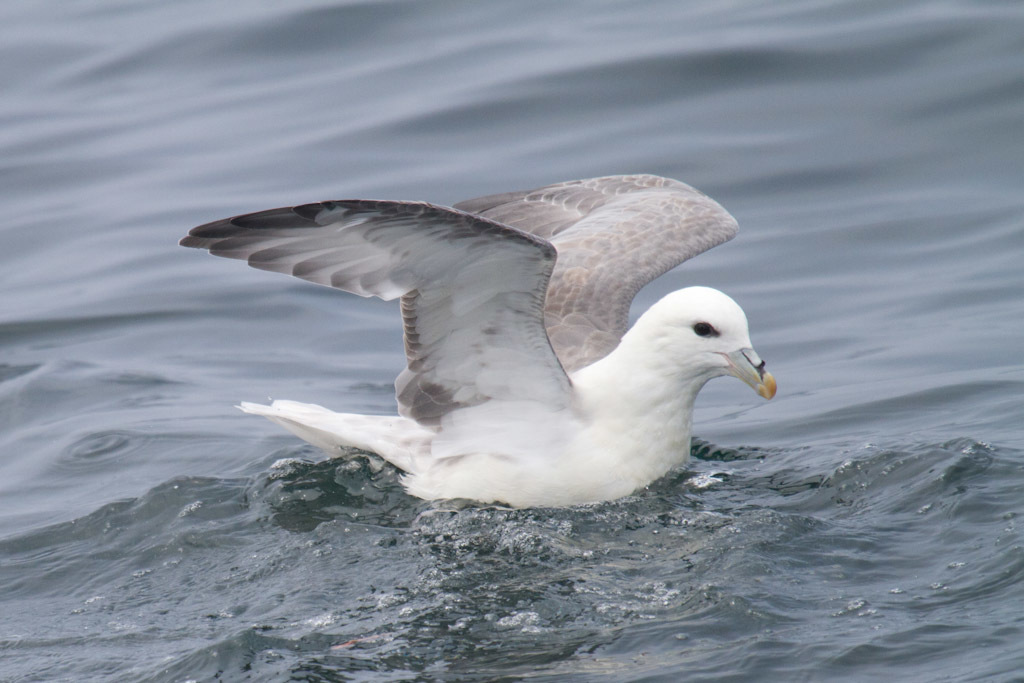
Northern Fulmar
Fulmarus glacialis
Also known as: Fulmar
Habitat
Aquatic
Diet
VertFishScav
Active Time
Diurnal
Size
612 g
About This Species
This stocky, tube-nosed seabird nests on sea cliffs and forages far offshore across the North Atlantic and Arctic, gliding low over waves on stiff wings in a distinctive shearing flight rather than flapping continuously. Its pale grey and white plumage and thick neck distinguish it from gulls at a distance, and it can be seen year-round near breeding cliffs, with peak colony activity in spring and summer. Sea-watching from headlands during onshore winds often gives good views of birds gliding past close to shore.
Ethical Viewing Guidelines
- Approaching cliff-nesting colonies too closely risks flushing adults, which can spit an oily stomach fluid at intruders as a defence and may abandon eggs if repeatedly disturbed, so viewing from a clifftop path or boat at a comfortable distance is preferable.
- Protection law for seabird cliffs differs across the countries bordering the North Atlantic and Arctic, so local site designations should be checked rather than assumed uniform.
- Staying back from unstable cliff edges is also a basic safety precaution at these sites.
Seasonal Activity
455,207 sightings · 2000–2026
Citizen science records via GBIF
Classification
- Kingdom
- Animalia
- Phylum
- Chordata
- Class
- Aves
- Order
- Procellariiformes
- Family
- Procellariidae
Traits
- Diet
- VertFishScav
- Foraging
- Aquatic
- Activity
- Diurnal
- Body mass
- 612 g
Photo
(c) Mark Rosenstein, some rights reserved (CC BY-NC)
CC-BY-NC-4.0
Occurrence data from GBIF.