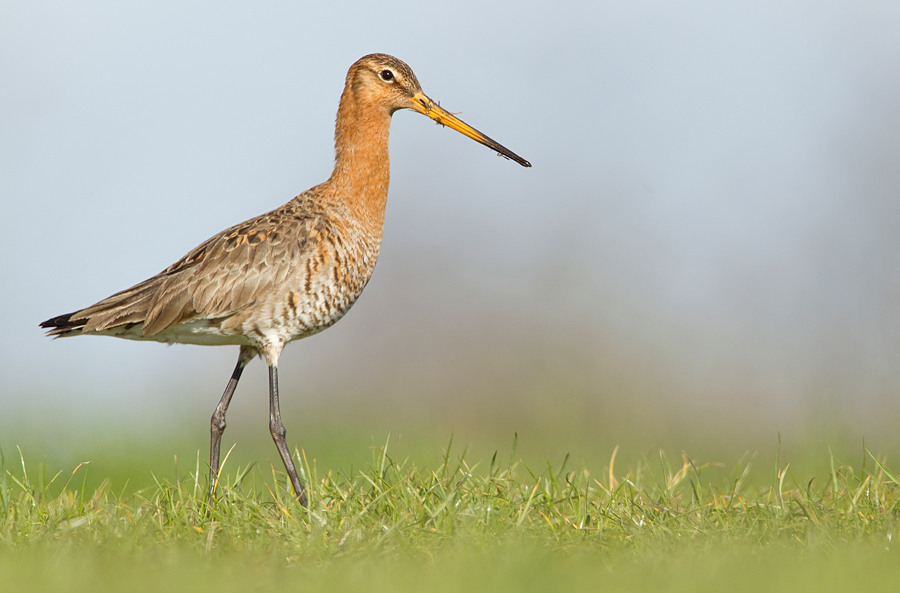
Black-Tailed Godwit
Limosa limosa
Habitat
Aquatic
Diet
Invertebrate
Active Time
Diurnal
Size
288 g
About This Species
A long-billed, long-legged wading bird of wet grasslands, estuaries and flooded fields across Europe and Asia, it probes deep in soft mud and shallow water for invertebrates, often wading up to its belly. Breeding birds show warm orange-brown tones on the head and breast, while non-breeding and migrant birds are greyer, and flocks can gather in large numbers at key estuaries during migration and winter. Spring passage and the winter months at traditional estuary sites offer the most reliable and often spectacular views of feeding flocks.
Ethical Viewing Guidelines
- As a species classed as Near Threatened, with breeding wet grassland habitat under pressure across much of its European range, extra care is warranted: keep well back from feeding or roosting flocks, avoid walking through wet grassland during the breeding season where birds may be nesting, and never approach a bird sitting low or acting distressed.
- Legal protection for this species and its habitat varies considerably across its European and Asian range, from strict nest and habitat protections in some countries to weaker enforcement elsewhere, so specific rules should be checked locally rather than assumed.
- Because flushing a feeding flock repeatedly can force birds to abandon a valuable stopover site altogether, using a scope from a hide or established path rather than walking out onto mudflats is the safer default everywhere.
Seasonal Activity
1,197,412 sightings · 2000–2026
Citizen science records via GBIF
Classification
- Kingdom
- Animalia
- Phylum
- Chordata
- Class
- Aves
- Order
- Charadriiformes
- Family
- Scolopacidae
Traits
- Diet
- Invertebrate
- Foraging
- Aquatic
- Activity
- Diurnal
- Body mass
- 288 g
Photo
(c) Paul Cools, some rights reserved (CC BY-NC), uploaded by Paul Cools
CC-BY-NC-4.0
Occurrence data from GBIF.