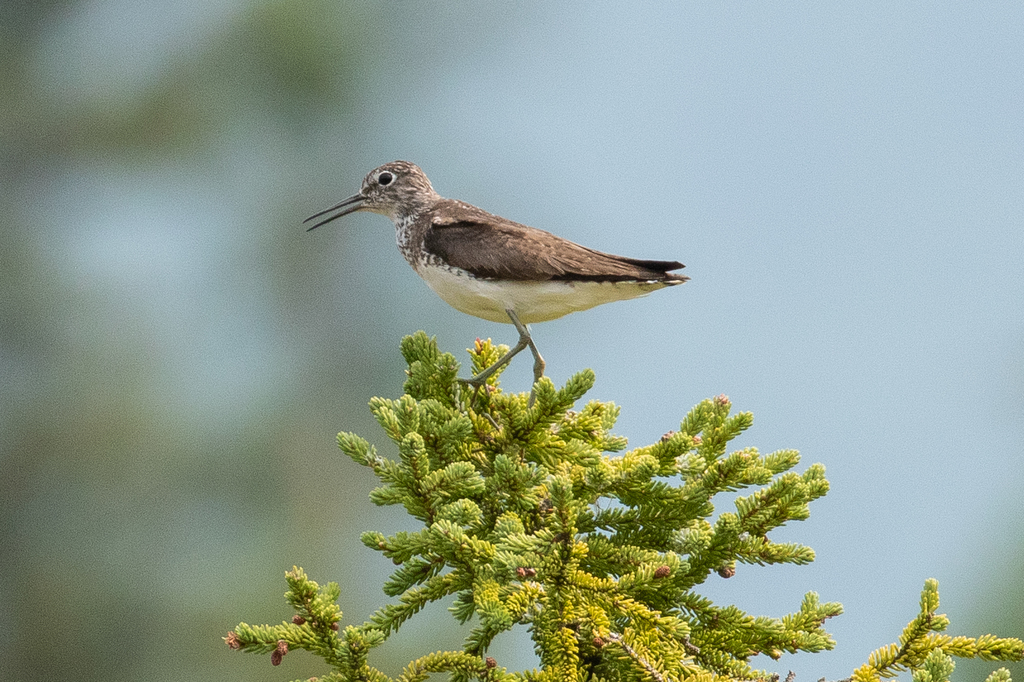
Solitary Sandpiper
Tringa solitaria
Also known as: Pond Bird
Habitat
Aquatic
Diet
Invertebrate
Active Time
Diurnal
Size
48 g
About This Species
Look for this slim, dark-backed sandpiper bobbing along the muddy edges of small woodland ponds, ditches, and forest pools rather than open shorelines, often alone as its name suggests. It has a distinctive teetering walk and a sharp, ascending call given in flight, and is most reliably seen during spring and fall migration as it moves between boreal breeding grounds and wintering areas in Central and South America. Quiet, overcast mornings at secluded freshwater edges tend to produce the best views.
Ethical Viewing Guidelines
- Stay at least 15-20 metres back and avoid flushing the bird from a feeding pool, since migrating shorebirds need to conserve energy and repeated disturbance along a stopover route can have a cumulative cost.
- Migratory bird protections apply across most of its range in North and South America, though enforcement and specific rules differ by country, so check local guidance rather than assuming uniform protection.
- Approach slowly and obliquely rather than directly, and retreat if the bird stops feeding to watch you.
Seasonal Activity
1,082,265 sightings · 2000–2026
Citizen science records via GBIF
Classification
- Kingdom
- Animalia
- Phylum
- Chordata
- Class
- Aves
- Order
- Charadriiformes
- Family
- Scolopacidae
Traits
- Diet
- Invertebrate
- Foraging
- Aquatic
- Activity
- Diurnal
- Body mass
- 48 g
Photo
(c) John D Reynolds, some rights reserved (CC BY-NC), uploaded by John D Reynolds
CC-BY-NC-4.0
Occurrence data from GBIF.