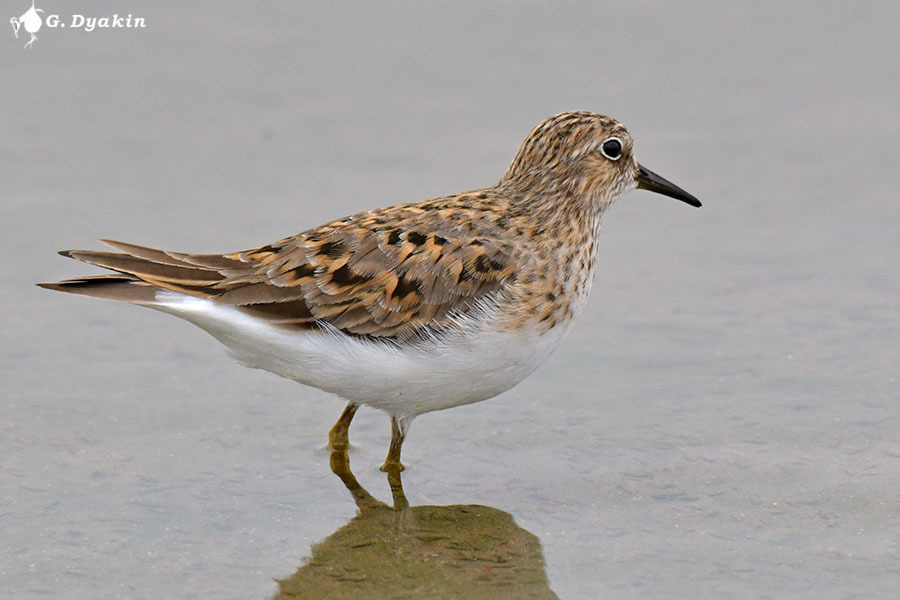
Temminck's Stint
Calidris temminckii
Habitat
Ground
Diet
Invertebrate
Active Time
Diurnal
Size
23 g
About This Species
A tiny, active wader, it forages by walking briskly along muddy edges of pools, marshes and rice paddies, picking at the surface for small invertebrates rather than probing deeply like some other sandpipers. It breeds on Arctic and subarctic tundra across northern Eurasia and winters as far as Africa and South Asia, so it is best looked for on passage in spring and autumn, or on wintering wetlands during the northern winter. Its crouching, quail-like posture when alarmed is a useful field mark alongside its small size.
Ethical Viewing Guidelines
- Approach muddy wader habitat slowly along the edge rather than walking directly out onto exposed mud, since flushing foraging shorebirds repeatedly costs them critical feeding time during migration and winter.
- It is covered by the African-Eurasian Migratory Waterbird Agreement and by the EU Birds Directive within Europe, but protections and enforcement vary considerably across its long migratory route through Asia and Africa.
- Because many wintering and staging sites are used by large mixed flocks, keeping a low profile and a generous distance benefits the whole group, not just this species.
Seasonal Activity
306,000 sightings · 2000–2026
Citizen science records via GBIF
Classification
- Kingdom
- Animalia
- Phylum
- Chordata
- Class
- Aves
- Order
- Charadriiformes
- Family
- Scolopacidae
Traits
- Diet
- Invertebrate
- Foraging
- Ground
- Activity
- Diurnal
- Body mass
- 23 g
Photo
(c) Геннадий Дякин, some rights reserved (CC BY-NC), uploaded by Геннадий Дякин
CC-BY-NC-4.0
Occurrence data from GBIF.