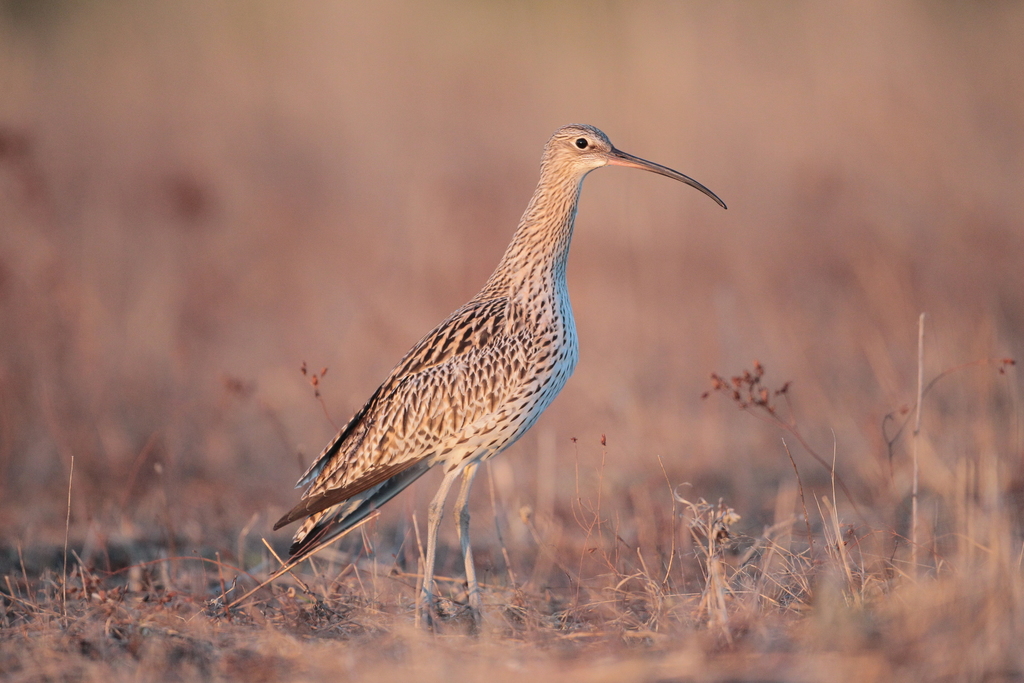
Eurasian Curlew
Numenius arquata
Also known as: Curlew, Western Curlew
Habitat
Ground
Diet
Omnivore
Active Time
Diurnal
Size
803 g
About This Species
Look for a large, long-legged wader probing wet grasslands, estuaries, and moorland edges with its distinctively long, downcurved bill, often working methodically across open ground at dawn and dusk when activity peaks. The far-carrying, bubbling *cur-lee* call is frequently the first indication of presence, particularly during the breeding season on upland moors from April through July, while estuaries and coastal mudflats hold good numbers of wintering birds from autumn through early spring. Visit tidal mudflats on a falling tide in overcast, calm conditions for the closest views, as birds become wary and flush readily under bright skies or in wind.
Ethical Viewing Guidelines
- Maintain a minimum distance of 100 metres at all times, increasing to 200 metres or more during the breeding season (April–July) when disturbance to nesting birds can cause nest abandonment.
- Across its range, this species receives legal protection under the EU Birds Directive, the UK Wildlife and Countryside Act 1981, and equivalent national legislation in many countries, making it an offence to intentionally disturb individuals at or near the nest.
- Use natural cover or a hide to conceal your presence, avoid prolonged observation if birds show signs of agitation such as alarm calling or repeated flushing, and keep dogs on leads in areas where the species is known to breed.
Seasonal Activity
2,215,721 sightings · 2000–2026
Citizen science records via GBIF
Classification
- Kingdom
- Animalia
- Phylum
- Chordata
- Class
- Aves
- Order
- Charadriiformes
- Family
- Scolopacidae
Traits
- Diet
- Omnivore
- Foraging
- Ground
- Activity
- Diurnal
- Body mass
- 803 g
Photo
(c) Вячеслав Ложкин, some rights reserved (CC BY-NC), uploaded by Вячеслав Ложкин
CC-BY-NC-4.0
Occurrence data from GBIF.