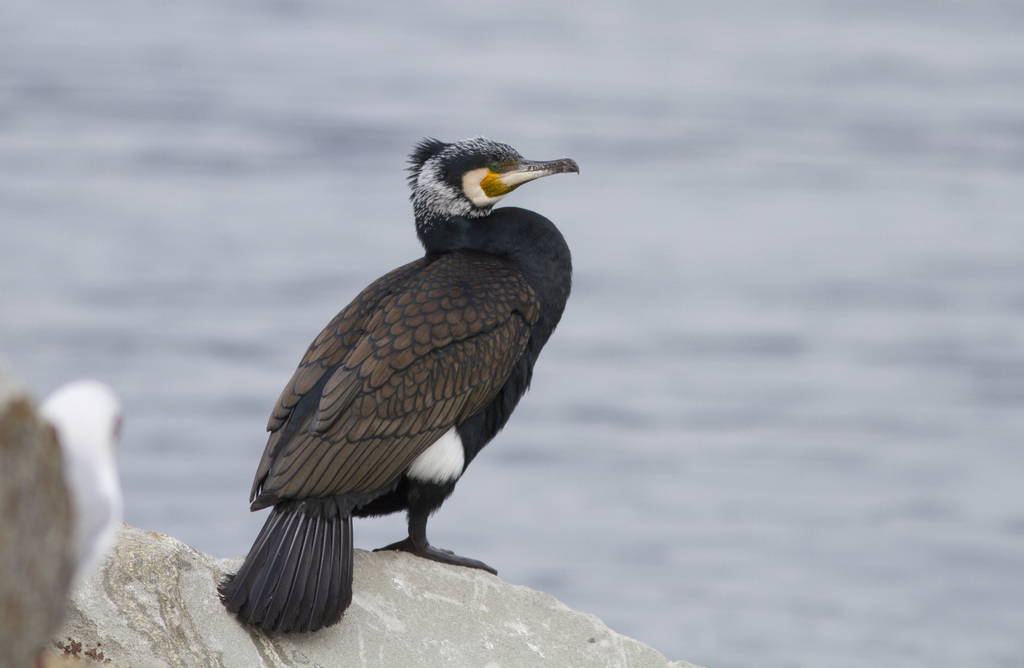
Great Cormorant
Phalacrocorax carbo
Also known as: Cormorant, Common Cormorant, Long-Tailed Cormorant, Black Shag, White-Breasted Cormorant
Habitat
Aquatic
Diet
VertFishScav
Active Time
Diurnal
Size
2.5 kg
About This Species
Look along coastal cliffs, estuaries, rivers and inland lakes for a large dark waterbird that dives to hunt fish and is frequently seen perched with wings held open to dry after fishing. It nests colonially on cliff ledges, in trees or on artificial structures, and is visible year-round across much of Europe. The wing-drying posture on rocks, posts or buoys is a distinctive giveaway even at a distance.
Ethical Viewing Guidelines
- Avoid approaching breeding colonies directly, since disturbance can cause a mass flush that leaves eggs or chicks exposed to predation or the weather.
- It is protected under the UK Wildlife and Countryside Act 1981 and equivalent European legislation, though in some regions it is subject to licensed control because of conflicts with fisheries, so protections can vary locally.
- Keep a clear distance from nesting colonies and viewing platforms rather than the colony itself are the better vantage point.
Seasonal Activity
6,232,486 sightings · 2000–2026
Citizen science records via GBIF
Classification
- Kingdom
- Animalia
- Phylum
- Chordata
- Class
- Aves
- Order
- Suliformes
- Family
- Phalacrocoracidae
Traits
- Diet
- VertFishScav
- Foraging
- Aquatic
- Activity
- Diurnal
- Body mass
- 2.5 kg
Photo
(c) Александр Гончаров, some rights reserved (CC BY-NC), uploaded by Александр Гончаров
CC-BY-NC-4.0
Occurrence data from GBIF.