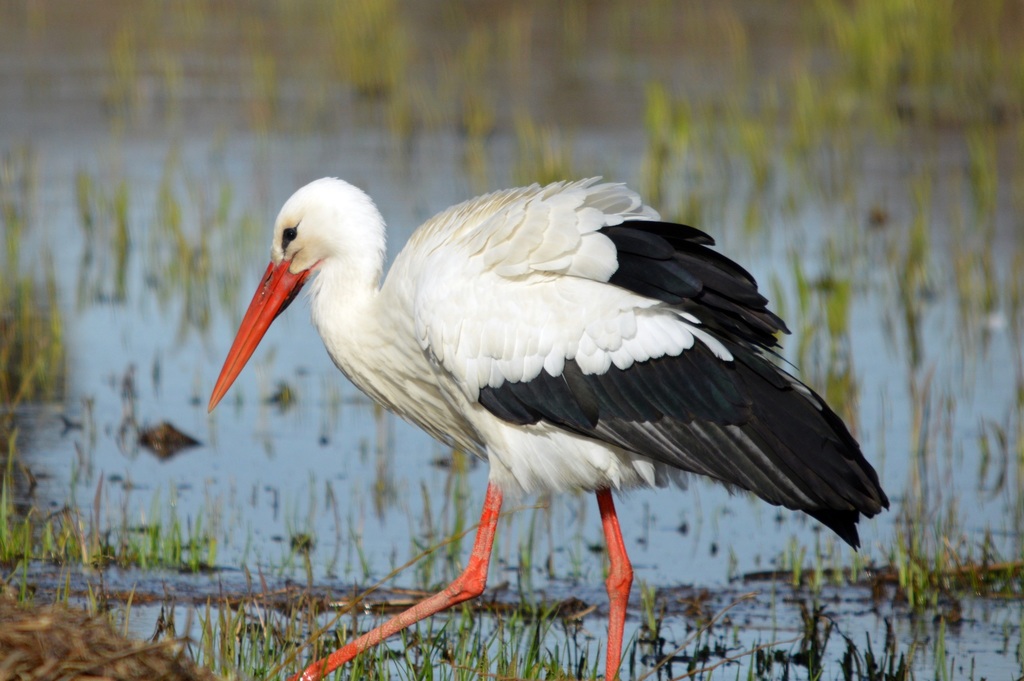
White Stork
Ciconia ciconia
Also known as: Cigonya Blanca, European White Stork
Habitat
Ground
Diet
VertFishScav
Active Time
Diurnal
Size
3.4 kg
About This Species
White Storks stalk slowly through wet meadows, farmland, and marsh edges hunting frogs, insects, and small mammals, and are just as recognisable for their enormous stick nests built on rooftops, chimneys, and purpose-built poles in towns across Europe. Migrating flocks soar on thermals in loose spirals during spring and autumn passage, often visible from a considerable distance as they move between European breeding grounds and African wintering areas. Spring, when pairs return to rebuild nests and perform loud bill-clattering displays, is a particularly rewarding time to watch them.
Ethical Viewing Guidelines
- Nesting storks in towns are used to people passing below and can be watched comfortably from the street, but avoid climbing to or handling nests, which are often reused for years and easily damaged.
- Protection for this species varies across its European, Middle Eastern, and African range, with many countries treating active nests as protected under wildlife or even cultural heritage rules, so check locally rather than assuming uniform protection.
- Give feeding birds in open fields a reasonable distance so they are not forced to abandon a hunting spot repeatedly.
Seasonal Activity
1,730,416 sightings · 2000–2026
Citizen science records via GBIF
Classification
- Kingdom
- Animalia
- Phylum
- Chordata
- Class
- Aves
- Order
- Ciconiiformes
- Family
- Ciconiidae
Traits
- Diet
- VertFishScav
- Foraging
- Ground
- Activity
- Diurnal
- Body mass
- 3.4 kg
Photo
(c) Jim, some rights reserved (CC BY-NC), uploaded by Jim
CC-BY-NC-4.0
Occurrence data from GBIF.