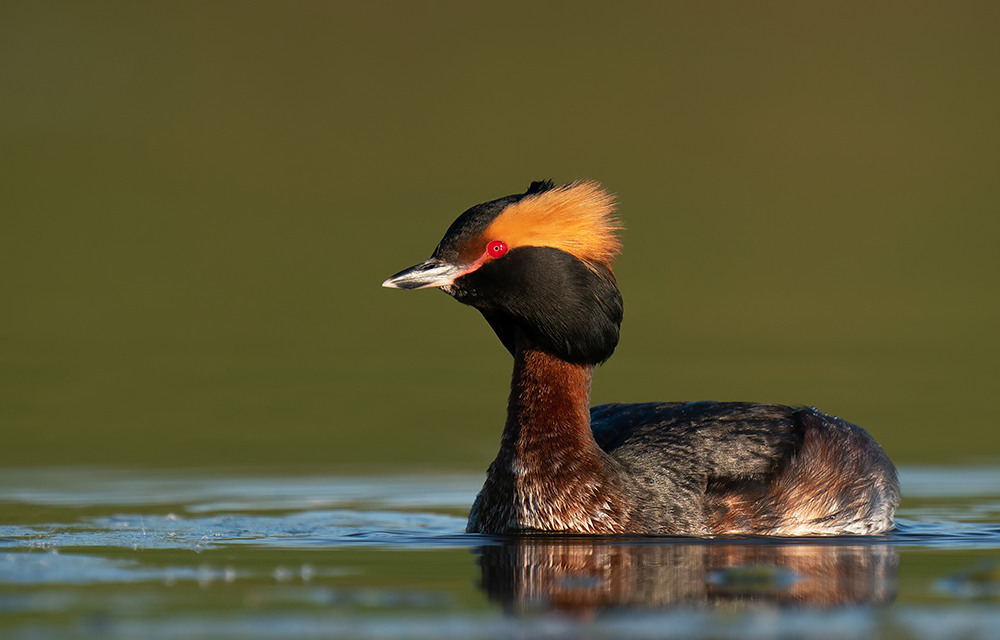
Horned Grebe
Podiceps auritus
Also known as: Slavonian Grebe
Habitat
Aquatic
Diet
VertFishScav
Active Time
Diurnal
Size
453 g
About This Species
Horned Grebes dive for small fish and aquatic invertebrates on quiet lakes, ponds, and sheltered coastal waters, disappearing underwater for surprisingly long stretches before resurfacing well away from where they submerged. Breeding birds in golden head plumes and a chestnut neck are most striking in spring on northern freshwater lakes across Canada, Alaska, and parts of northern Europe, while duller grey-and-white winter birds are found on coastal bays further south. Calm, clear mornings on open water give the best chance of a sustained view before the bird dives again.
Ethical Viewing Guidelines
- Because this species is globally Vulnerable with a declining population, keep well back, ideally observing from shore with binoculars or a scope rather than approaching by boat or kayak, since repeated disturbance on breeding lakes can cause nest abandonment.
- Wild bird protection laws apply across its breeding and wintering range in North America and Europe, though specific distance requirements vary by country and protected area, so follow the most cautious posted guidance where it exists.
- Never approach a nest, raft of chicks, or a bird performing distraction displays, and give wintering flocks a wide berth so they are not forced into repeated, energy-costly dives.
Seasonal Activity
1,754,934 sightings · 2000–2026
Citizen science records via GBIF
Classification
- Kingdom
- Animalia
- Phylum
- Chordata
- Class
- Aves
- Order
- Podicipediformes
- Family
- Podicipedidae
Traits
- Diet
- VertFishScav
- Foraging
- Aquatic
- Activity
- Diurnal
- Body mass
- 453 g
Photo
(c) Paul Cools, some rights reserved (CC BY-NC), uploaded by Paul Cools
CC-BY-NC-4.0
Occurrence data from GBIF.