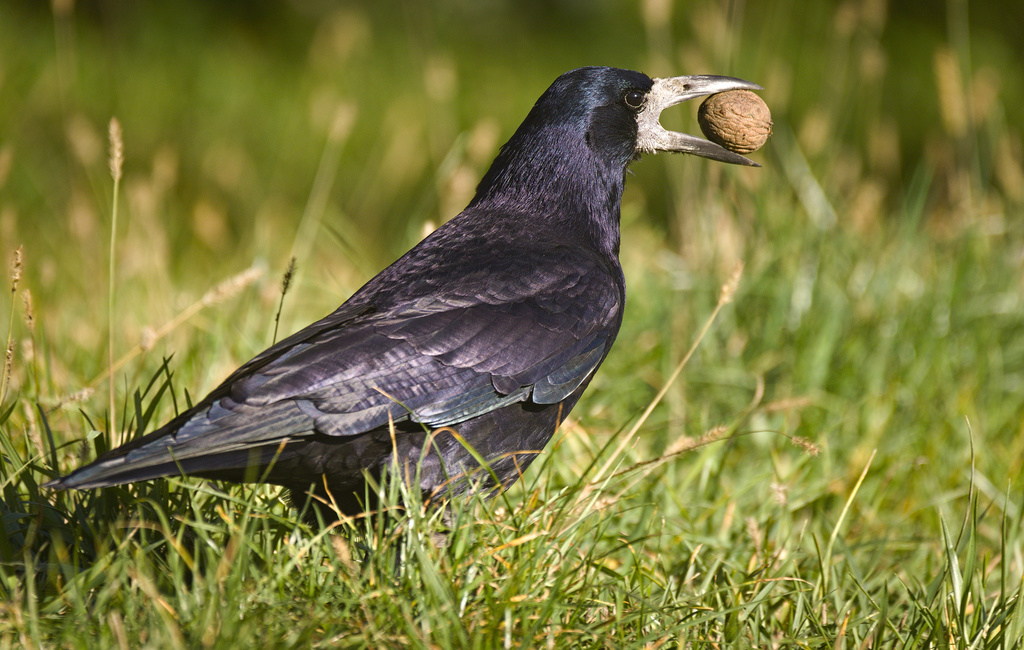
Rook
Corvus frugilegus
Habitat
Ground
Diet
Omnivore
Active Time
Diurnal
Size
452 g
About This Species
A highly social corvid of farmland and open country across Europe, it forms large, noisy breeding colonies, known as rookeries, in the tops of tall trees, and forages on the ground in fields and pasture, probing soil with its long bill for invertebrates. Look for the pale, bare patch of skin at the base of the bill that separates it from similar all-black crows. Late winter into spring, when rookeries are active with nest building and calling, and large post-breeding roosts in autumn and winter, both offer good viewing.
Ethical Viewing Guidelines
- Rookeries can be watched comfortably from below or from a nearby path without needing to approach the nest trees directly, since disturbance at the colony can cause adults to abandon nests.
- Wild birds, their nests, and eggs are protected in the UK under the Wildlife and Countryside Act 1981 and under equivalent national laws implementing the EU Birds Directive elsewhere in its range.
- Large ground-feeding flocks in fields are tolerant of quiet observers at a normal distance.
LCAvesPasseriformesCorvidae
Seasonal Activity
1,620,808 sightings · 2000–2026
Citizen science records via GBIF
All monthsThis month
Classification
- Kingdom
- Animalia
- Phylum
- Chordata
- Class
- Aves
- Order
- Passeriformes
- Family
- Corvidae
Traits
- Diet
- Omnivore
- Foraging
- Ground
- Activity
- Diurnal
- Body mass
- 452 g
Photo
(c) hedera.baltica, some rights reserved (CC BY-SA)
CC-BY-SA-4.0
Occurrence data from GBIF.