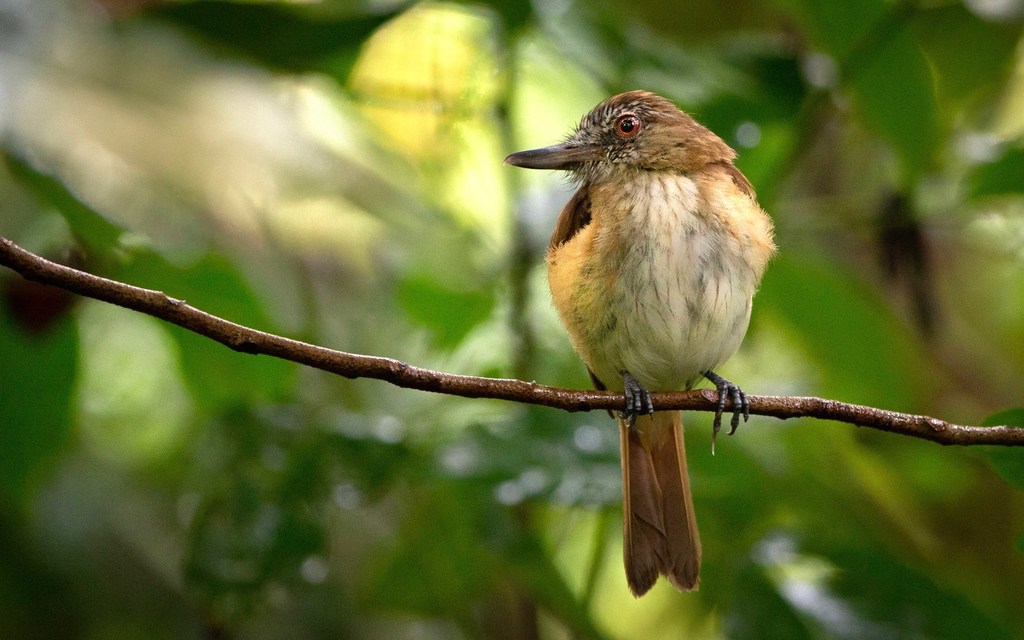
Bright-Rumped Attila
Attila spadiceus
About This Species
This stocky flycatcher favours the mid to upper canopy of humid lowland and foothill forest, forest edge, and older second growth from Mexico south through much of tropical South America. It is far easier to hear than see: listen for its loud, rising, whistled song, often given from a hidden perch, and watch for a bird sitting motionless before sallying out after large insects or small vertebrates. Dawn and the early morning chorus are the best times to pick up the call and track it to a perch.
Ethical Viewing Guidelines
- As a widespread species of least concern, no special legal distance applies, but as with most forest birds a slow, quiet approach and use of binoculars rather than closing the gap will keep it in view longer without cutting short feeding or singing.
- Avoid broadcasting recorded calls repeatedly to draw it in, since frequent playback can disrupt normal territorial behaviour.
LCAvesPasseriformesTyrannidae
Seasonal Activity
217,537 sightings · 2000–2026
Citizen science records via GBIF
All monthsThis month
Classification
- Kingdom
- Animalia
- Phylum
- Chordata
- Class
- Aves
- Order
- Passeriformes
- Family
- Tyrannidae
Photo
(c) Sergio Rivero Beneitez, some rights reserved (CC BY-NC-SA), uploaded by Sergio Rivero Beneitez
CC-BY-NC-SA-4.0
Occurrence data from GBIF.