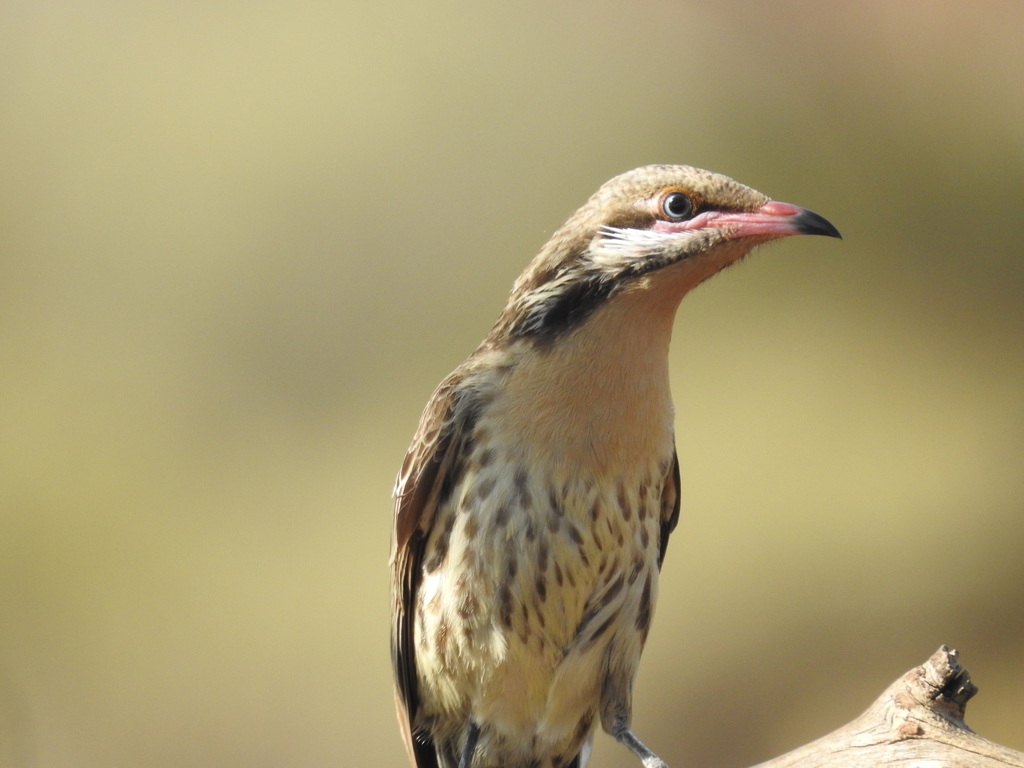
Spiny-Cheeked Honeyeater
Acanthagenys rufogularis
About This Species
Moves through arid and semi-arid woodland, mallee, and scrub feeding on nectar from flowering eucalypts and grevilleas as well as insects and fruit, often in noisy, loose flocks. Its loud, musical, chattering calls carry well and are usually the first clue to its presence before it comes into view. Flowering season for eucalypts and other nectar-bearing shrubs, which varies by region, brings the highest concentrations of birds.
Ethical Viewing Guidelines
- A few metres' distance at a flowering shrub is usually enough not to disrupt feeding, since the birds are generally confident around slow, quiet observers.
- Native bird species are protected under Australian state and territory wildlife legislation, so nests should never be approached or handled.
- Keep noise down near active nest sites, which are typically built low in dense shrubs.
LCAvesPasseriformesMeliphagidae
Seasonal Activity
228,625 sightings · 2000–2026
Citizen science records via GBIF
All monthsThis month
Classification
- Kingdom
- Animalia
- Phylum
- Chordata
- Class
- Aves
- Order
- Passeriformes
- Family
- Meliphagidae
Photo
(c) littlellama, some rights reserved (CC BY-NC), uploaded by littlellama
CC-BY-NC-4.0
Occurrence data from GBIF.