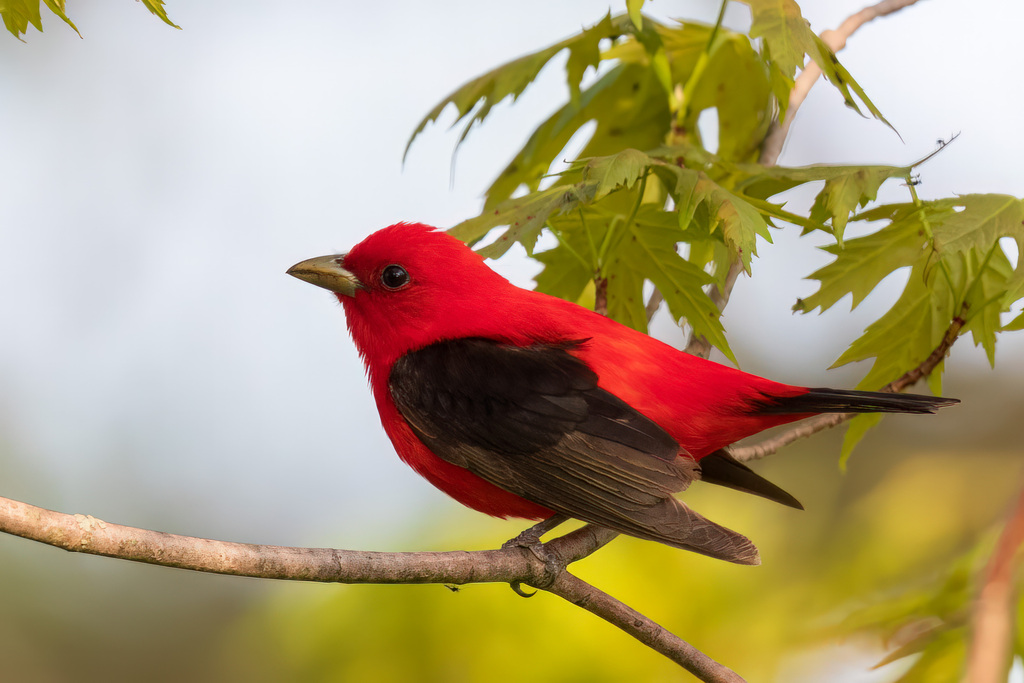
Scarlet Tanager
Piranga olivacea
Habitat
Mid-canopy
Diet
Invertebrate
Active Time
Diurnal
Size
28 g
About This Species
Scarlet Tanagers spend most of their time high in the leafy mid-canopy of mature deciduous forest, making them easier to hear than see, with a burry, robin-like song and a sharp chick-burr call note. Breeding males in brilliant red and black plumage stand out against summer foliage in eastern North American woodlands, though patience and binoculars pointed upward are usually required. Late spring through early summer, once trees have leafed out but before the canopy grows too dense, offers the best combination of singing activity and visibility.
Ethical Viewing Guidelines
- Viewing from the ground below the canopy causes essentially no disturbance, so there is no need to approach closely; a stationary position under the right tree is usually enough.
- In the United States and Canada it is protected under migratory bird treaty legislation, prohibiting disturbance of nests or capture of birds.
- Avoid playback recordings during the breeding season, since repeated calling can pull territorial males away from nest defence and mate guarding.
Seasonal Activity
1,761,632 sightings · 2000–2026
Citizen science records via GBIF
Classification
- Kingdom
- Animalia
- Phylum
- Chordata
- Class
- Aves
- Order
- Passeriformes
- Family
- Cardinalidae
Traits
- Diet
- Invertebrate
- Foraging
- Mid-canopy
- Activity
- Diurnal
- Body mass
- 28 g
Photo
(c) brian stahls, some rights reserved (CC BY-NC), uploaded by brian stahls
CC-BY-NC-4.0
Occurrence data from GBIF.