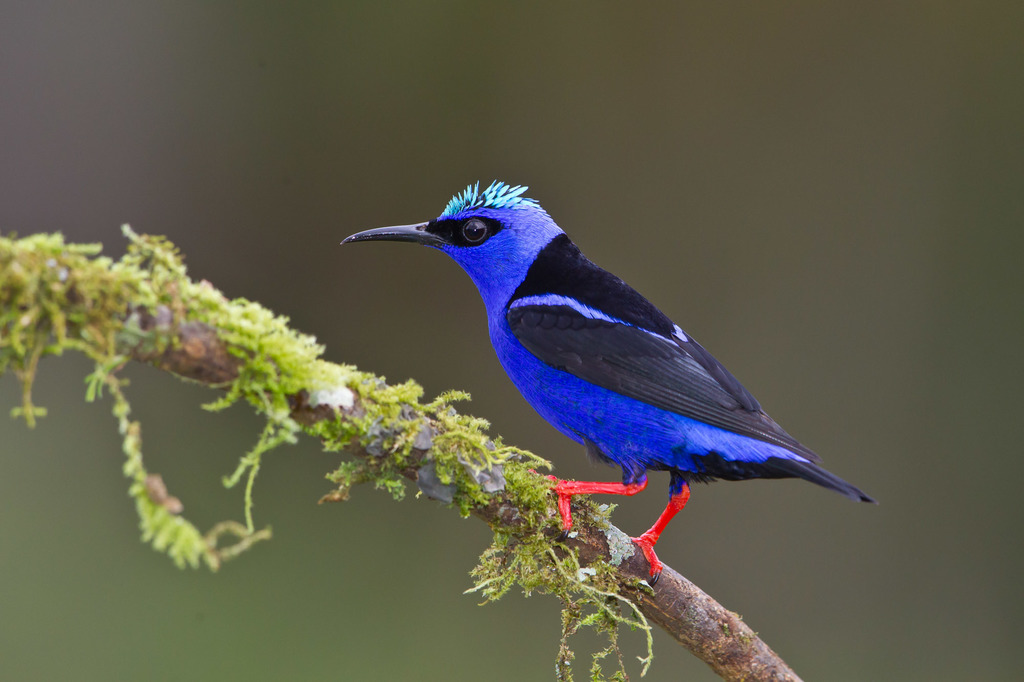
Red-Legged Honeycreeper
Cyanerpes cyaneus
Also known as: Blue Honeycreeper
About This Species
This small, brilliantly coloured honeycreeper favours forest edges, plantations and gardens with flowering trees from Mexico through much of northern South America, where males show a striking turquoise-blue body against black wings and females are a more subdued green. It feeds on nectar, small fruit and insects, often moving in small mixed groups through the mid and upper canopy, and is most active and easiest to see in the cooler hours of early morning. Flowering or fruiting trees are the best bet for a reliable sighting.
Ethical Viewing Guidelines
- Viewing from a stationary spot near a flowering tree rather than approaching a feeding bird works best, since it will simply move off into cover if pressed.
- Protection of native birds is written into law across its Central and South American range, though enforcement and specific rules vary by country, so nests and eggs should never be handled or collected.
- Keeping noise and movement to a minimum near a fruiting or flowering tree lets a group continue feeding naturally.
Seasonal Activity
250,711 sightings · 2000–2026
Citizen science records via GBIF
Classification
- Kingdom
- Animalia
- Phylum
- Chordata
- Class
- Aves
- Order
- Passeriformes
- Family
- Thraupidae
Photo
(c) Greg Lasley, some rights reserved (CC BY-NC), uploaded by Greg Lasley
CC-BY-NC-4.0
Occurrence data from GBIF.