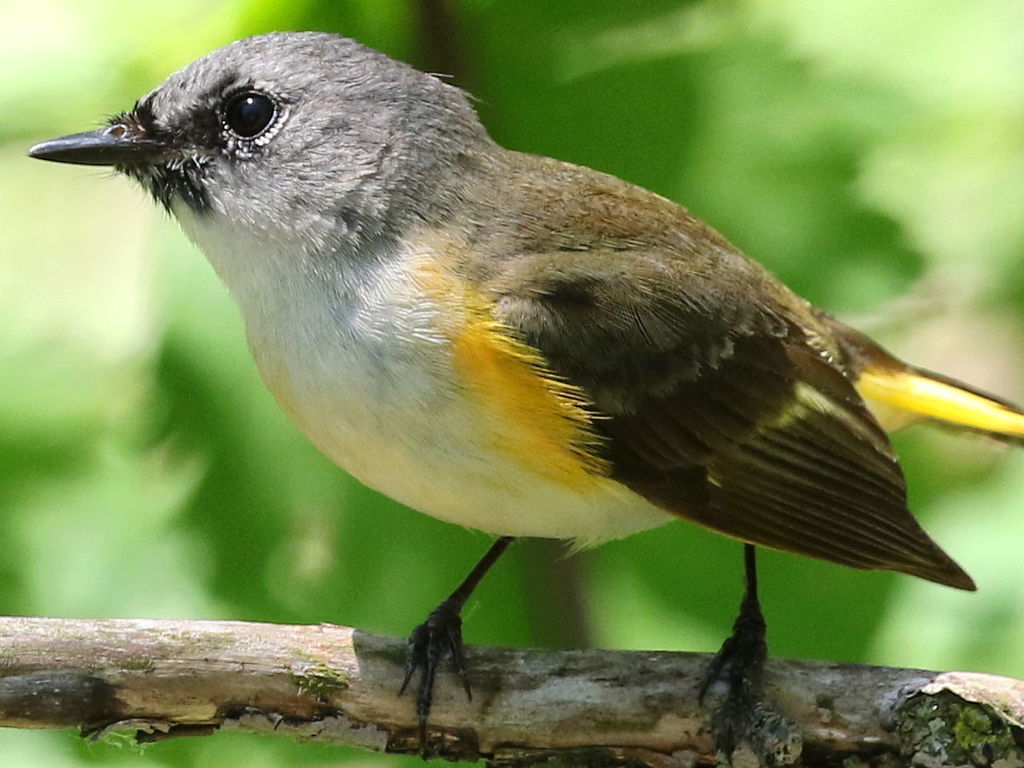
American Redstart
Setophaga ruticilla
Also known as: Little Cheechee Bird
Habitat
Mid-canopy
Diet
Invertebrate
Active Time
Diurnal
Size
8 g
About This Species
Check the mid-levels of deciduous woodland edges, streamside thickets, and second-growth forest in eastern and northern North America, where this small warbler flits restlessly among branches. Males are unmistakable, flashing black, orange, and white as they fan their tail and spread their wings to startle insects into flight, a foraging habit that makes them easier to spot than many warblers. Late spring through early summer, during the breeding season, is the best window, when singing males are most active and vocal in the canopy.
Ethical Viewing Guidelines
- Stay back at least 10-15 metres and let the bird continue its natural foraging rather than following it through the brush, since repeated pursuit can interrupt feeding and breeding behavior.
- As a migratory songbird breeding in the US and Canada and wintering in the Caribbean and Central America, it is protected under migratory bird laws in its northern range, with additional protections applying in some wintering countries, so treat playback and close approaches to nests with particular restraint during the breeding season.
- If an adult starts giving sharp chip notes or drops food and pauses, it is signaling stress and you should step back.
Seasonal Activity
3,910,744 sightings · 2000–2026
Citizen science records via GBIF
Classification
- Kingdom
- Animalia
- Phylum
- Chordata
- Class
- Aves
- Order
- Passeriformes
- Family
- Parulidae
Traits
- Diet
- Invertebrate
- Foraging
- Mid-canopy
- Activity
- Diurnal
- Body mass
- 8 g
Photo
(c) Peter Chen 2.0, some rights reserved (CC BY), uploaded by Peter Chen 2.0
CC-BY-4.0
Occurrence data from GBIF.