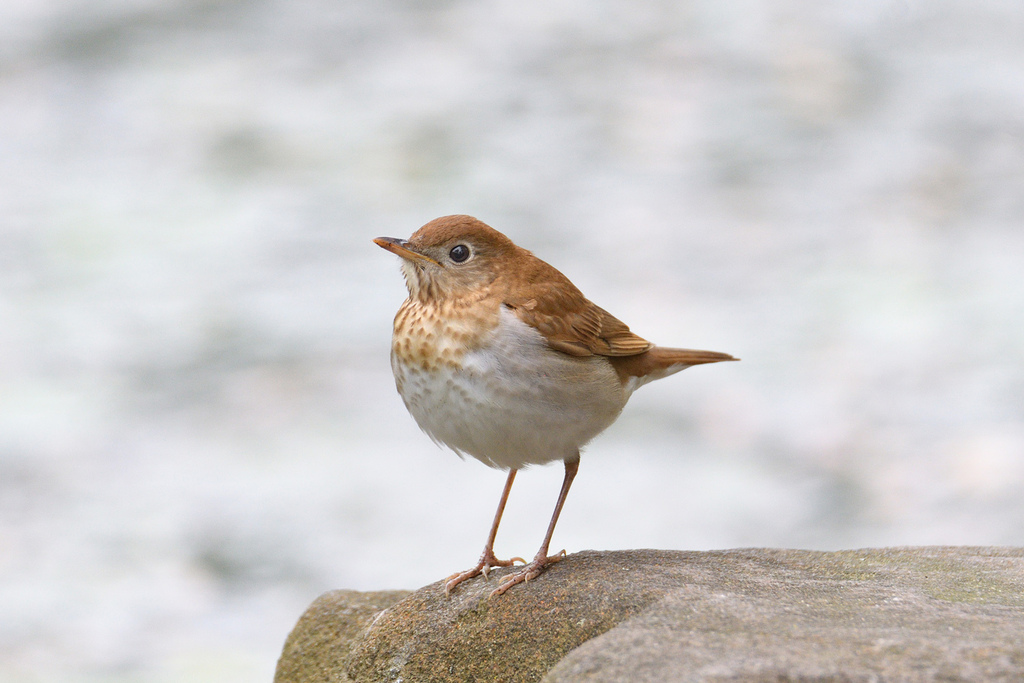
Veery
Catharus fuscescens
Habitat
Ground
Diet
Omnivore
Active Time
Diurnal
Size
32 g
About This Species
This warm cinnamon-brown thrush is more often heard than seen, foraging quietly on the floor of moist deciduous woodland across the northern United States and Canada in summer. Its song, a descending, flute-like spiral of notes, is one of the most distinctive sounds of dusk in eastern forests and is the most reliable way to confirm its presence. Listening at dawn or dusk from late spring through mid-summer, near damp woodland with a shaded understorey, gives the best chance of hearing a singing male.
Ethical Viewing Guidelines
- Because it nests and feeds directly on the ground, staying on established trails through breeding habitat avoids trampling nest sites that are otherwise very hard to spot.
- It is a migratory species protected under federal law in the United States and Canada, and nests should never be searched for or handled even briefly.
- A distance of 15-20 metres while listening to a singing bird is enough to enjoy the song without causing it to fall silent or move off.
Seasonal Activity
1,354,076 sightings · 2000–2026
Citizen science records via GBIF
Classification
- Kingdom
- Animalia
- Phylum
- Chordata
- Class
- Aves
- Order
- Passeriformes
- Family
- Turdidae
Traits
- Diet
- Omnivore
- Foraging
- Ground
- Activity
- Diurnal
- Body mass
- 32 g
Photo
(c) terence zahner, some rights reserved (CC BY-NC), uploaded by terence zahner
CC-BY-NC-4.0
Occurrence data from GBIF.