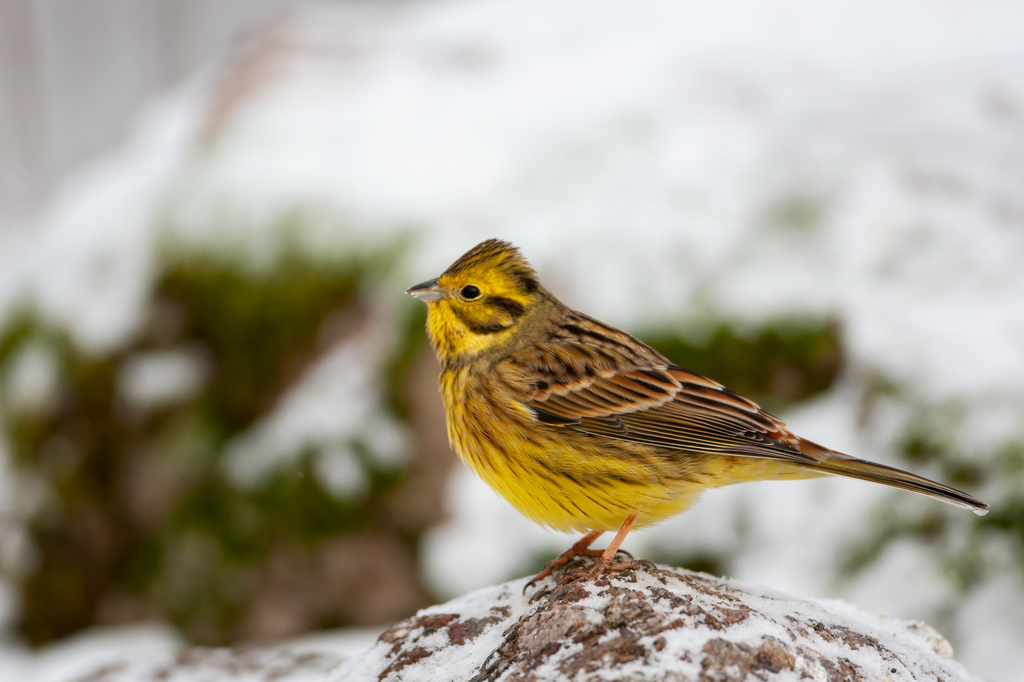
Yellowhammer
Emberiza citrinella
Also known as: Eurasian Yellow Bunting
Habitat
Ground
Diet
PlantSeed
Active Time
Diurnal
Size
30 g
About This Species
Found along farmland hedgerows, field margins, and scrubby edges across the UK and much of Europe, where males sing "a little bit of bread and no cheese" from an exposed perch such as a wire or bush top through spring and summer. Look for the bright yellow head and breast against streaked chestnut-brown plumage, and listen for the song in open arable country rather than woodland. Numbers are easiest to find in early morning during the breeding season, with small flocks gathering around stubble fields and farm tracks in winter.
Ethical Viewing Guidelines
- A short pause at a respectful distance with binoculars is normally enough, since flushing a singing male from its perch interrupts territorial defence with little benefit to the observer.
- In the UK it is protected under the Wildlife and Countryside Act, which makes it an offence to intentionally disturb nesting birds, and similar general protections for wild birds apply across the EU under the Birds Directive; avoid approaching hedgerows closely during the March to August breeding season.
- Sticking to field margins and paths rather than pushing into hedge cover is the simplest way to avoid disturbing a nest that may not be visible.
Seasonal Activity
2,920,922 sightings · 2000–2026
Citizen science records via GBIF
Classification
- Kingdom
- Animalia
- Phylum
- Chordata
- Class
- Aves
- Order
- Passeriformes
- Family
- Emberizidae
Traits
- Diet
- PlantSeed
- Foraging
- Ground
- Activity
- Diurnal
- Body mass
- 30 g
Photo
(c) Pekka Malinen, some rights reserved (CC BY-NC-SA), uploaded by Pekka Malinen
CC-BY-NC-SA-4.0
Occurrence data from GBIF.