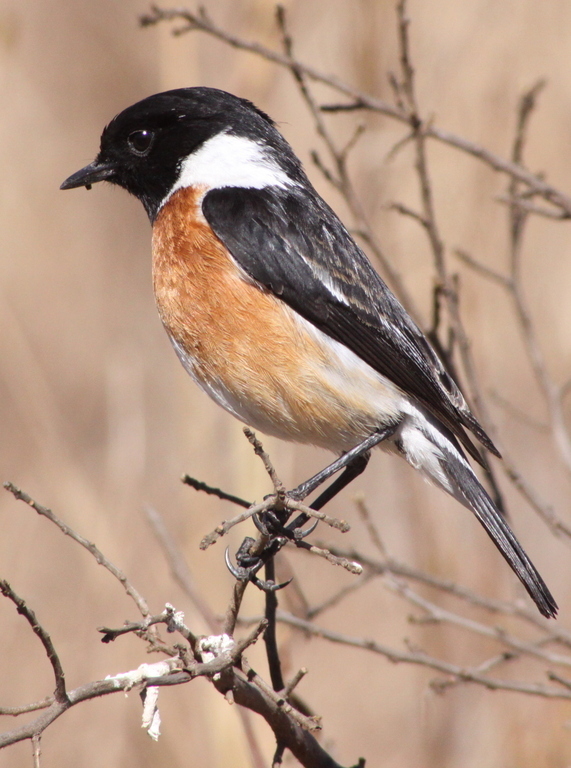
African Stonechat
Saxicola torquatus
Also known as: Stonechat, Common Stonechat, Eurasian Stonechat
Habitat
Ground
Diet
Invertebrate
Active Time
Diurnal
Size
14 g
About This Species
Watch for it perched upright on low bushes, fence wires or grass stems across open scrub, heathland and farmland throughout its African and wider range, from where it drops to the ground to catch insects before returning to the same perch. Males show a dark head and orange breast that contrast with a pale collar, making them easy to pick out even at a distance. It is present year-round in much of its range and is most active foraging in the cooler parts of the day.
Ethical Viewing Guidelines
- Because it perches conspicuously and forages close to the ground, it is easy to approach too closely without realizing it; watching from a stationary position rather than walking toward a perched bird reduces the chance of flushing it repeatedly.
- Wildlife protections vary across the many African and Eurasian countries where it occurs, so local regulations should be checked rather than assumed uniform.
- Avoiding close approach to low, well-hidden nests during the breeding season is the most important precaution given how the species nests near ground level.
LCAvesPasseriformesMuscicapidae
Seasonal Activity
303,269 sightings · 2000–2026
Citizen science records via GBIF
All monthsThis month
Classification
- Kingdom
- Animalia
- Phylum
- Chordata
- Class
- Aves
- Order
- Passeriformes
- Family
- Muscicapidae
Traits
- Diet
- Invertebrate
- Foraging
- Ground
- Activity
- Diurnal
- Body mass
- 14 g
Photo
(c) Derek Keats, some rights reserved (CC BY)
CC-BY-4.0
Occurrence data from GBIF.