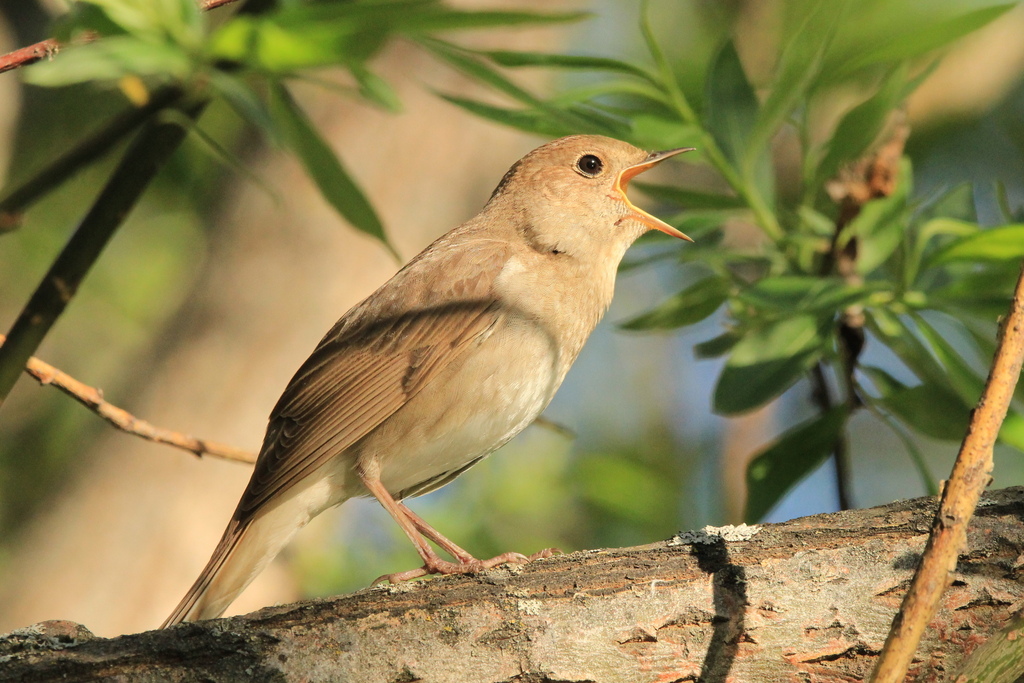
Thrush Nightingale
Luscinia luscinia
Also known as: Sprosser
Habitat
Ground
Diet
Invertebrate
Active Time
Diurnal
Size
24 g
About This Species
This is a bird best located by ear: its rich, powerful, and unusually loud nocturnal song from dense scrub, thickets, and riverside vegetation is far more distinctive than any brief visual glimpse, since it stays low and skulks in cover. Listen at dusk and after dark in late spring and early summer on the breeding grounds, when unmated males sing persistently through much of the night. During migration it can turn up briefly in scrub and hedgerows well outside its breeding range, but is much harder to detect without song.
Ethical Viewing Guidelines
- Stay on paths and listen from a distance rather than pushing into dense scrub to find the singing bird, since flushing it from cover interrupts breeding behaviour and the species relies on thick undergrowth it will not return to quickly if disturbed.
- Nesting songbirds and their habitat receive general legal protection across most of this species' breeding range, so avoid approaching a singing male's territory closely enough to risk finding or disturbing a nest.
- A quiet, stationary listening approach at a reasonable distance reveals far more than an attempt to see the bird directly.
Seasonal Activity
467,381 sightings · 2000–2026
Citizen science records via GBIF
Classification
- Kingdom
- Animalia
- Phylum
- Chordata
- Class
- Aves
- Order
- Passeriformes
- Family
- Muscicapidae
Traits
- Diet
- Invertebrate
- Foraging
- Ground
- Activity
- Diurnal
- Body mass
- 24 g
Photo
(c) yury-redkin, some rights reserved (CC BY-NC), uploaded by yury-redkin
CC-BY-NC-4.0
Occurrence data from GBIF.