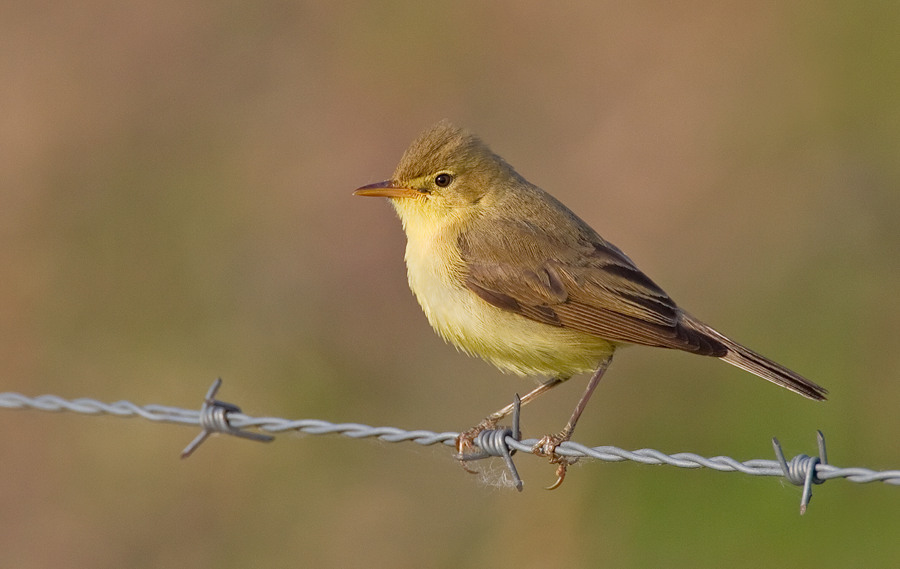
Melodious Warbler
Hippolais polyglotta
Habitat
Understory
Diet
Invertebrate
Active Time
Diurnal
Size
11 g
About This Species
Search dense hedgerows, scrubby woodland edges and riverside thickets across southwestern Europe and northwest Africa, where it skulks low in foliage and is detected far more often by its rich, rambling song than by sight. Listen for a long, varied warble delivered from cover during late spring and early summer on breeding territory, since the bird itself keeps well hidden in leafy tangles. Migration brings brief appearances in more open scrub during spring and autumn passage.
Ethical Viewing Guidelines
- Observe from outside dense hedgerow cover rather than pushing in to find a singing bird, since this reduces disturbance to a well-concealed nest.
- Nest protections apply across its European breeding range and African wintering grounds, though the specific rules differ by country, so any nest found by chance should be left undisturbed and unphotographed at close range.
LCAvesPasseriformesAcrocephalidae
Seasonal Activity
326,171 sightings · 2000–2026
Citizen science records via GBIF
All monthsThis month
Classification
- Kingdom
- Animalia
- Phylum
- Chordata
- Class
- Aves
- Order
- Passeriformes
- Family
- Acrocephalidae
Traits
- Diet
- Invertebrate
- Foraging
- Understory
- Activity
- Diurnal
- Body mass
- 11 g
Photo
(c) Paul Cools, some rights reserved (CC BY-NC), uploaded by Paul Cools
CC-BY-NC-4.0
Occurrence data from GBIF.