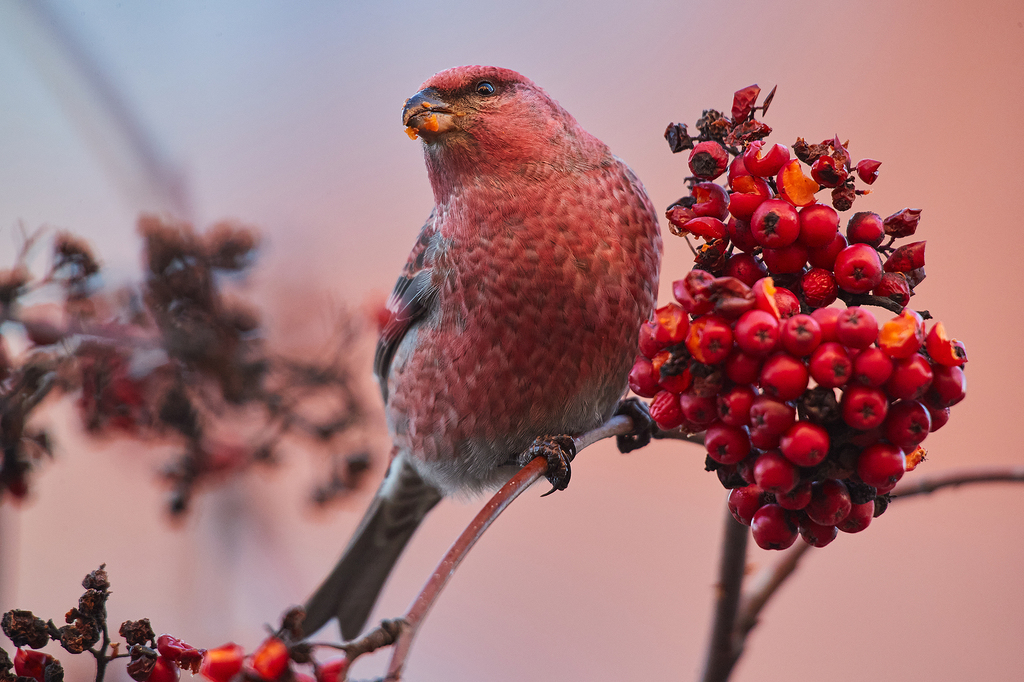
Pine Grosbeak
Pinicola enucleator
Habitat
Mid-canopy
Diet
PlantSeed
Active Time
Diurnal
Size
56 g
About This Species
This large, plump finch inhabits boreal and subalpine coniferous forests across the northern hemisphere, feeding in mid-canopy on buds, seeds and berries, sometimes descending to eat roadside grit or salt. Males show rosy-red plumage while females and immatures are more olive-grey, and small flocks can often be located by their soft, whistled calls as they move through spruce or pine stands. Winter is often the best season to see them at lower elevations or further south, when food scarcity pushes flocks toward more accessible habitat.
Ethical Viewing Guidelines
- These finches are frequently quite tame and can be watched at close range without deliberate approach, but it is still better to let birds come to a stationary observer than to walk toward a feeding flock.
- Wildlife protection law differs between the countries spanning its circumpolar range, so specific rules should be checked locally rather than assumed to be uniform.
- Avoiding prolonged disturbance at roadside grit sites in winter, when energy reserves are already stretched, is a reasonable precaution.
Seasonal Activity
460,813 sightings · 2000–2026
Citizen science records via GBIF
Classification
- Kingdom
- Animalia
- Phylum
- Chordata
- Class
- Aves
- Order
- Passeriformes
- Family
- Fringillidae
Traits
- Diet
- PlantSeed
- Foraging
- Mid-canopy
- Activity
- Diurnal
- Body mass
- 56 g
Photo
(c) Дмитрий Осипов, some rights reserved (CC BY-NC), uploaded by Дмитрий Осипов
CC-BY-NC-4.0
Occurrence data from GBIF.