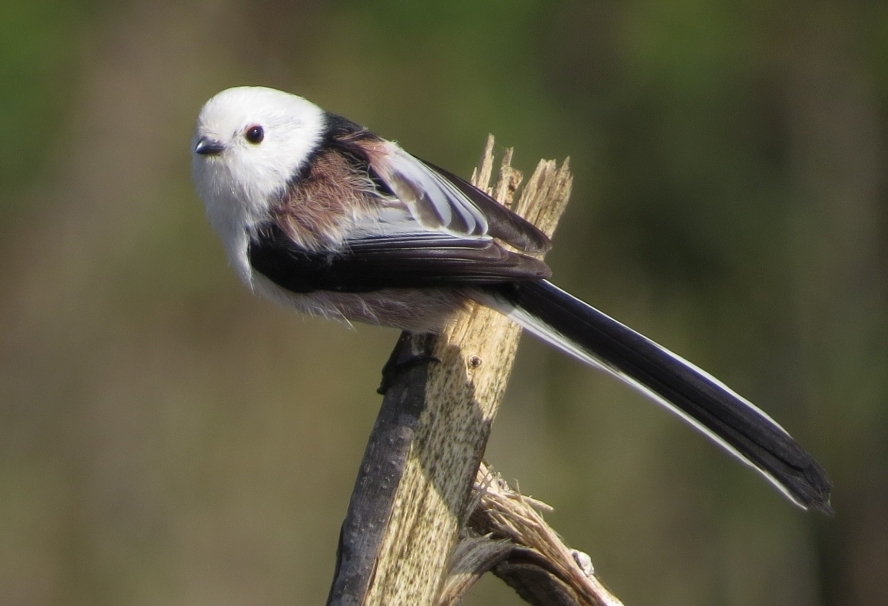
Long-Tailed Tit
Aegithalos caudatus
Also known as: Long-Tailed Bushtit
Habitat
Understory
Diet
Invertebrate
Active Time
Diurnal
Size
9 g
About This Species
A tiny, highly social bird usually seen moving through woodland, hedgerows and gardens in noisy, restless flocks, its long tail and fluffy pink-tinged plumage make it easy to identify once seen. Listen for its distinctive trilling and soft contact calls, often the first clue that a flock is passing through before individual birds are spotted. Autumn and winter are the easiest times to see them, when family flocks forage together through bare hedgerows and woodland edges.
Ethical Viewing Guidelines
- These birds build a remarkable enclosed, camouflaged nest low in dense hedges or scrub, so avoid probing into thick vegetation during the spring breeding season where a nest could be hidden.
- Wild birds and their nests are protected by law in the UK and across much of Europe, though the details vary by country.
- Observing a foraging flock quietly from a short distance without following it through the undergrowth is the least disruptive approach.
Seasonal Activity
2,930,414 sightings · 2000–2026
Citizen science records via GBIF
Classification
- Kingdom
- Animalia
- Phylum
- Chordata
- Class
- Aves
- Order
- Passeriformes
- Family
- Aegithalidae
Traits
- Diet
- Invertebrate
- Foraging
- Understory
- Activity
- Diurnal
- Body mass
- 9 g
Photo
(c) Luca Boscain, some rights reserved (CC BY-NC), uploaded by Luca Boscain
CC-BY-NC-4.0
Occurrence data from GBIF.