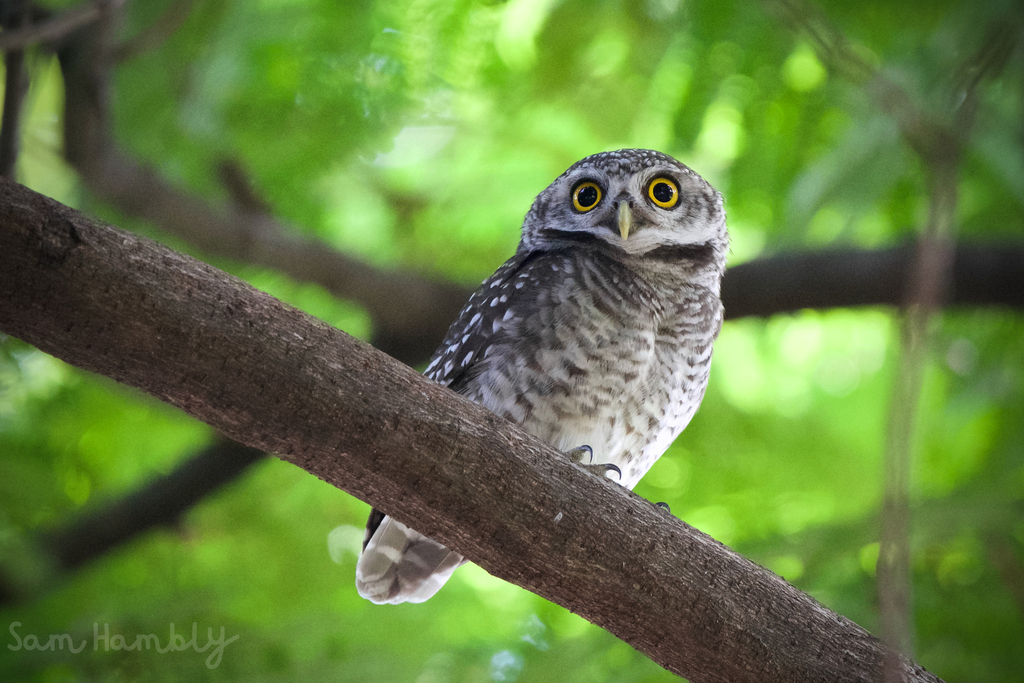
Spotted Owlet
Athene brama
About This Species
A small, compact owl of the Indian subcontinent, it roosts by day in tree hollows, old buildings, and ruins, often in pairs peering out from a cavity entrance. It becomes active around dusk, when its yapping and chuckling calls carry from gardens, groves, and village outskirts, and careful listening near a known roost hole is the most reliable way to find one. Cooler months with clear evenings tend to give the most consistent activity.
Ethical Viewing Guidelines
- Once a roost hole is found, view from a distance with binoculars rather than approaching the tree or shining bright lights directly into the cavity, since repeated flushing can cause a pair to abandon a roost.
- It is legally protected under India's Wildlife Protection Act, where disturbing or capturing it is an offence, and similar bird-protection statutes apply elsewhere in its South Asian range.
- If a roost is near a nest with young, keep visits brief and infrequent.
LCAvesStrigiformesStrigidae
Seasonal Activity
207,417 sightings · 2000–2026
Citizen science records via GBIF
All monthsThis month
Classification
- Kingdom
- Animalia
- Phylum
- Chordata
- Class
- Aves
- Order
- Strigiformes
- Family
- Strigidae
Photo
(c) Sam Hambly, some rights reserved (CC BY-NC), uploaded by Sam Hambly
CC-BY-NC-4.0
Occurrence data from GBIF.